






































































































A blank twelve-foot wall is the most expensive feature in any room, because it pulls the eye and gives nothing back. Large abstract wall art is the fastest way to fix that, and the most common place buyers overspend on the wrong piece. The mistake is rarely taste; it is scale, finish, or wall construction the buyer never thought to check. This guide walks through how to compare large abstract wall art options, where to place oversized non-figurative pieces, and when a bespoke commission earns its keep.

Quick Answer: What to Decide Before You Buy
Scale first: measure the wall and aim for large abstract wall art that covers 60 to 75 percent of the available width.
Material second: carved wood, sculpted acrylic, textured composite and metal each read very differently in raking light.
Depth matters: 3D wall art casts shadow and reads as sculpture; flat canvas reads as a picture.
Fixings: drywall, plaster, brick and stone all need different anchors. Check before you commit.
Bespoke vs. ready-made: if the wall is over 8 ft (2.4 m) wide or oddly proportioned, commissioning a large abstract wall art piece usually wins.

What Large Abstract Wall Art Actually Means
Large is a slippery word. In a Manhattan loft, large abstract wall art might mean a 7 ft (2.1 m) wide panel above the sofa. In an Aspen great room with double-height ceilings, it might mean a 12 ft (3.7 m) triptych mounted above a stone fireplace. The honest definition we use in the studio: a piece is large when it becomes the room's anchor rather than an accessory.
Abstract is the easier half. The work avoids literal subject matter and instead carries the room through gesture, texture, rhythm or color field. That makes oversized non-figurative work unusually flexible. Abstract large wall art will sit comfortably in a minimalist Napa wine cellar, a maximalist Dallas dining room, or a corporate lobby in Midtown, where figurative art would feel either too specific or too risky for a shared audience.
Large abstract wall art is best suited for: high-ceilinged living rooms, double-height stairwells, hospitality lobbies, executive offices, primary bedroom walls behind the headboard, and long hallways that need a focal stop rather than a row of small frames.
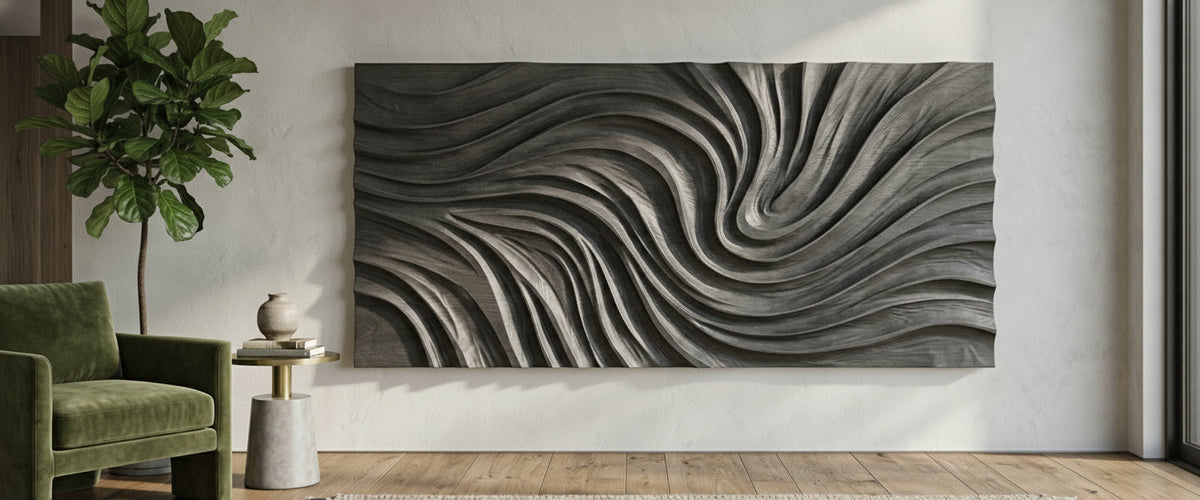
A carved relief sized to two-thirds of the sofa width, lit by raking afternoon sun.
How to Compare Large Abstract Wall Art Options Before Buying
Treat the decision like buying a sculpture, because at this scale that is what you are doing. Run every shortlisted piece of large abstract wall art through five filters before adding anything to a cart.
1. Read the Piece in Raking Light
Most oversized abstract pieces are photographed flat and head-on. That hides the single most important quality of a 3D piece: how it behaves when sunlight or a wall washer hits it from the side. Carved wood and sculpted acrylic come alive under raking light; printed canvas does not. If the wall gets directional light at any point in the day, prioritize large abstract wall art with real relief.
2. Check the Substrate, Not Just the Surface
A carved wood panel mounted on a warped MDF backer will telegraph that flaw within two summers in a centrally heated home. Ask what the panel is built on, how it is sealed, and whether it is braced for humidity swings. Reputable makers will answer this in one email.
3. Confirm Hanging Hardware Is Rated for Weight
Big pieces routinely run 30 to 80 lbs (14 to 36 kg). French cleats are the standard for anything over 25 lbs (11 kg) because they spread load and lock the piece tight to the wall. Single-point picture wire is not acceptable at this scale.
4. Look at the Edges
Edges are where cheap large abstract wall art gives itself away. A finished piece has clean returns, painted or veneered edges, and no visible fixings from any angle. If the listing photos crop tight on the face, ask for an edge-on shot before buying.
5. Pressure-Test the Color in Your Light
Charcoal reads warm under 2700K bulbs and cool under 4000K. Mocha reads pink in north light and brown in south light. Request a physical sample or a digital mockup taken in your room's light temperature before signing off on a panel that will dominate the space for the next decade.
Key Materials, Finishes and Scale Decisions
Material drives almost everything in large abstract wall art: weight, depth, light behavior, longevity, and how the piece ages. Here is how the main options compare in real homes.
Carved Wood Panels
Carved wood reads warm and tactile, and the relief catches light beautifully on textured walls and Venetian plaster. In rooms built around stone, leather and linen, a deep-cut charcoal panel such as the Deralin Charcoal Flow Abstract 3D Carving Wall Art echoes the natural materials around it without competing with them. Above pale oak floors and travertine, warmer tones tend to settle in better; something like the Deralin Mocha Stroke Abstract 3D Carving Wall Art is closer to the right register for those palettes.
Sculpted Acrylic and UV-Print Composites
For wider placement ideas, Wood Wall Art: A Buyer's Guide to Scale, Carving, and Placement is useful companion reading before finalising the setting and sightlines.
Acrylic 3D pieces give you precision lines and a cleaner, more contemporary read. Where the setting needs a contemporary reflection rather than the weight of carved hardwood, a minimal acrylic relief like the Linea Abstract Embrace Minimal Acrylic UV 3D Wall Art is closer to the right design language. Acrylic also handles humidity better than wood, which makes it the sensible choice for powder rooms, primary bathrooms and pool houses.
Textured Composite Reliefs
Floral-abstract hybrids sit between sculpture and painting, reading as abstract from across a room and revealing botanical structure up close. That double-read is useful in dining rooms and hospitality spaces where guests view the piece from multiple distances, and a neutral sandstone palette like the Bloomark Sandstone Floral Abstract Texture 3D Wall Art tends to hold up across more varied lighting than a stronger color choice would.
Metal Wall Sculpture
For commercial lobbies, double-height residential walls and exterior covered porches, brushed stainless, blackened steel or patinated bronze wall sculpture outlives every other form of large abstract wall art. It also reads as a serious art commitment, which matters for corporate and hospitality buyers.
Side-by-side samples make finish, depth and edge quality easier to judge than catalog photography.
Scale Rule of Thumb
Above a sofa, aim for large abstract wall art that runs roughly two-thirds the sofa width. Above a console or fireplace, match or slightly exceed the furniture width. On a blank feature wall, fill 60 to 75 percent of the wall width and leave generous breathing room at top and bottom rather than pushing the piece to the ceiling.
Where to Place Large Wall Art Abstract Pieces for the Strongest Impact
The strongest placements for large abstract wall art share one trait: the viewer sees the piece from a controlled distance, not from three feet away. That is why stairwells, double-height living rooms and long sightlines work so well. The eye gets to take the whole composition in at once.
Above the primary sofa: the default, and still the best return on investment. Hang so the center sits 60 to 65 inches (152 to 165 cm) from the floor when measured to the artwork's midpoint.
Double-height stairwells: oversized vertical pieces or stacked diptychs handle the wall's awkward proportions better than any framed print.
Behind a freestanding tub: sculpted acrylic or sealed composite handles bathroom humidity. Avoid raw wood here.
Dining room feature wall: textured large abstract wall art reads beautifully in candlelight and warm pendant glow.
Hospitality and office lobbies: neutral palettes and abstract gesture age better than colorful figurative work in shared spaces.
Powder rooms: yes, a sizeable piece works in a small powder room, provided the wall is long enough to view it from at least 6 ft (1.8 m) back. In tighter rooms, choose a piece with shallower relief so the door clears it.
For a wider view of options across formats, the abstract art collection groups pieces by visual language rather than only by material, which is useful when you are still narrowing the mood.
Budget, Commissioning and Delivery
Pricing for abstract wall art large enough to anchor a room depends on material, scale, depth of relief, finishing process, edition status and crating. A 4 ft (1.2 m) ready-made composite panel and a 12 ft (3.7 m) bespoke carved triptych are not the same product, and the gap between them is wide. Rather than chase a number, ask for a tailored quote against your wall dimensions and material preference; any serious maker of large abstract wall art will return one within a few working days.
Three cost levers worth knowing about:
Panel construction: single panel vs. diptych or triptych changes shipping and install cost as much as it changes the art.
Finish: hand-applied patinas, gilding and multi-layer lacquers add real labor hours.
Crating and freight: oversize pieces ship in custom crates. International freight to the US, Canada or Australia is a separate quote and typically includes white-glove install for anything over 7 ft (2.1 m).
If you are commissioning large abstract wall art, expect a typical timeline of eight to sixteen weeks from approved design to delivery, longer for carved hardwood or cast metal. The studio will normally provide a scaled mockup against a photo of your wall before any cutting begins. For care guidance on indoor sculptural finishes, the American Institute for Conservation publishes useful homeowner-facing material on caring for art and decorative objects.
How Giant Sculptures Handles Bespoke Wall Art Projects
Most of the oversized wall pieces we ship are not catalog purchases. They are large abstract wall art commissions sized to a specific wall, finished to match a specific palette, and built to survive specific conditions, such as a Florida pool house or a Colorado mountain home with extreme humidity swings. A recent project for a Napa winery tasting room needed a 14 ft (4.3 m) carved relief mounted on a curved plaster wall; the install required a French cleat machined to the wall's radius and shipped pre-fitted. That kind of detail is what bespoke buys you.
Working with us on a large abstract wall art commission usually follows four stages: design conversation, scaled visual against your wall photo, sample of the chosen material and finish, then build and crated delivery. Browse the wall art collection as a starting point for material and scale, then send the wall measurements and a couple of room photos to begin a commission.
A Short Buyer Checklist
Measure the wall width, height, and any obstructions (sconces, vents, switches).
Photograph the wall in morning and evening light.
Decide on relief depth: flat, low-relief, or full 3D sculpture.
Confirm wall construction and pick the right anchor system.
Request edge-on photos and material samples before committing.
Plan delivery access: door widths, elevator dimensions, stair turns.
Ask about cleaning, refinishing and long-term care for the specific material.
Done well, a single piece of large abstract wall art will outlast three sofa refreshes and two repaints. Choose for the wall you have, not the wall in the photograph.