





































































































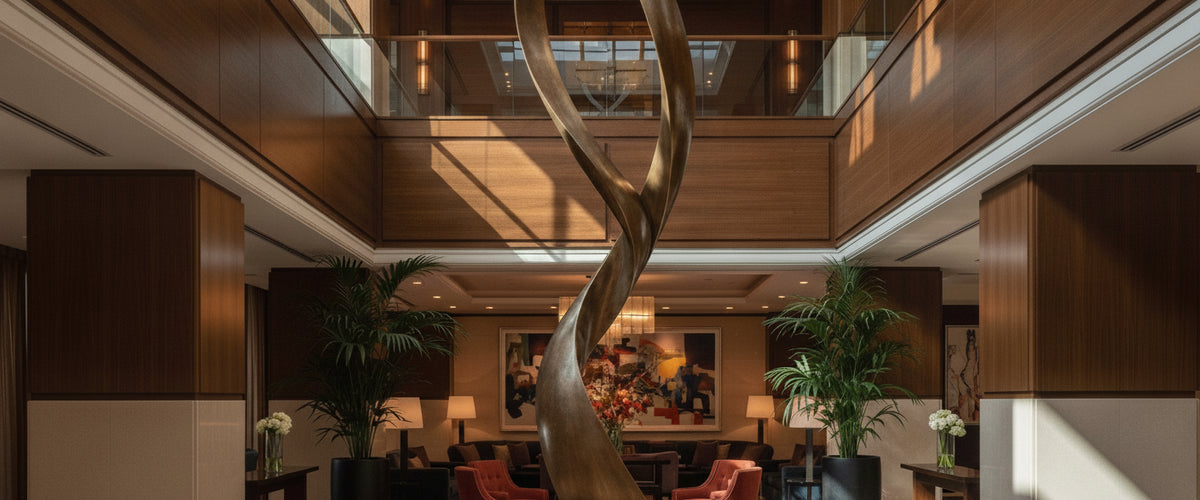

A guest's first thirty seconds inside your lobby decide whether they reach for their phone or for the check-in desk. That window is the entire job description of a hotel lobby sculpture. Done well, it sets the tone for the rate card, the bar program, and the design language of every floor above it. Done badly, the hotel lobby sculpture looks like an oversized prop nobody can quite explain.
This guide is written for owners, general managers, interior designers, and architects briefing a flagship hotel lobby sculpture for a new build or a refurbishment. It assumes you are not shopping for a side-table accent. You are choosing a sculpture that has to anchor a double-height volume, survive twenty years of cleaning crews, and read well in both daylight and the warm glow of evening check-in.

Quick Answer: What a Hotel Lobby Sculpture Needs to Do
Anchor the volume. The hotel lobby sculpture should match the ceiling height and sightlines, not the furniture.
Survive the traffic. Materials must shrug off cleaning chemicals, luggage trolleys, and the occasional curious hand.
Photograph well from three angles. Reception desk view, lounge view, and the shot guests take from the entrance.
Carry the brand without shouting it. Abstract forms age better than literal motifs.
Be installable. Door widths, floor loading, and lift access decide what is actually possible.

What a Hotel Lobby Sculpture Really Means
The phrase covers a wider range than most briefs admit. At one end you have a single freestanding figure or abstract form placed on a plinth near the entrance. At the other you have suspended installations spanning a four-story atrium, or a wall-mounted relief running the length of a reception desk. A sculpture in a hotel lobby is any three-dimensional work commissioned or sourced specifically to act as the focal point of that arrival sequence.
The buyer is rarely a private collector. It is usually an owner working with a design studio, a hospitality group standardizing a flagship look, or an architect filling a volume they designed two years earlier. Each of those buyers wants different things from a hotel lobby sculpture. The owner cares about longevity and guest reaction. The designer cares about how the piece holds the room together. The architect cares about proportion and material conversation with the building itself. A good arrival piece answers all three at once.
Materials and Finishes That Earn Their Place
For wider placement ideas, Bedroom Art Trends Designers Are Using Right Now is useful companion reading before finalizing the setting and sightlines.
Hotel lobby sculptures live a hard life. They face polished concrete dust, mop splash, hand contact, ambient humidity from revolving doors, and the long, slow effect of HVAC cycling year-round. Material choice is not a styling decision; it is a maintenance contract.
Bronze remains the default for figurative and classical work. A patinated bronze figure, properly waxed, can sit in a lobby for decades with nothing more than an annual care visit. Patinas read warm under tungsten and hold their character against marble flooring. For a flagship property aiming at a heritage feel, a cast bronze hotel lobby sculpture from a collection like our bronze sculptures range is usually the right starting point.
Stainless steel is the modernist choice for a hotel lobby sculpture. Mirror-polished steel reflects the room and effectively doubles your lighting design, which is useful in lobbies that go dim after sunset. Brushed or satin finishes hide fingerprints better, which matters when the piece sits within arm's reach of the reception queue. A large abstract form in stainless can dominate a contemporary atrium without feeling heavy; see what scale looks like in our stainless steel sculptures collection.
Stone and marble bring weight, literal and visual. A carved marble piece reads as permanent, which works well in hotels that want to signal long-term ownership rather than a quick refresh. The trade-off is floor loading. A 6 ft (1.8 m) marble figure can weigh 1,500 to 2,500 lbs (680 to 1,130 kg) before the plinth, and that number changes what your structural engineer will sign off.
Corten steel works for lobbies that open onto courtyards or have a strong indoor-outdoor relationship. Indoors a Corten hotel lobby sculpture needs to be stabilized; the raw weathering finish that looks honest in a garden will mark a pale marble floor if it is not sealed properly.
The Getty Conservation Institute publishes useful technical guidance on the long-term behavior of metals and stone in interior environments, and it is worth reading before you sign off on a finish specification.
Scale Decisions: Reading the Room Properly
The most common mistake we see in hotel lobby sculpture briefs is undersizing. A piece chosen at human scale (5 to 6 ft / 1.5 to 1.8 m) gets lost the moment it sits inside a 20 ft (6 m) ceiling volume. The rule of thumb our studio uses: the work's vertical presence should occupy roughly one third to one half of the visual void it sits inside, measured from plinth base to the upper sightline a guest sees on entry.
For a standard double-height lobby of around 18 to 22 ft (5.5 to 6.7 m), that usually puts the piece itself in the 8 to 12 ft (2.4 to 3.6 m) range, on a plinth of 18 to 36 in (45 to 90 cm). Suspended works follow different math; there you are designing for the upward gaze from the entrance, and the bottom edge should sit clear of any sightline blocking the reception desk.
One detail that gets forgotten: luggage. A guest pulling a hard-shell case needs roughly a 4 ft (1.2 m) turning circle. Hotel lobby sculptures placed too close to the natural walking line collect scuffs on their plinths within the first year. We typically advise a clearance zone of at least 3 ft (90 cm) on all approachable sides, more if the work sits near the entrance doors.
Placement: Where the Sculpture Actually Works
Placement is a sightline exercise before it is an aesthetic one. Walk the guest's actual path: revolving door, ten steps in, glance toward reception, glance toward the lounge, glance up. Wherever those glances naturally land is where the hotel lobby sculpture belongs.
Centered on the entry axis is the strongest position. The work becomes the visual full stop at the end of the arrival walk. This suits symmetrical lobbies with a clear back wall behind the piece.
Off-axis at the reception flank suits asymmetrical layouts and properties where the check-in experience needs to feel intimate rather than ceremonial. The hotel lobby sculpture acts as a wayfinding cue, drawing the eye toward the desk without competing with it.
Inside the lounge zone works when the lobby and bar share a single volume. Here the work is doing double duty: focal point for arrivals and conversation anchor for guests sitting with a drink. Figurative pieces tend to outperform abstract ones in this position because guests want something to look at while they wait.
Suspended overhead is the most dramatic option for a hotel lobby sculpture and the most expensive to engineer. Rigging, load calculations, and access for future cleaning all need to be agreed with the structural team before the design is locked. It is worth it in atriums where the floor is too busy to give a large piece proper breathing room.
Budget, Commissioning and Delivery
Budget for a hotel lobby sculpture is shaped by six variables: material, scale, complexity of form, engineering for installation, finish quality, and crating and freight. Two pieces of the same height can quote very differently because one is a simple cast form and the other involves armatures, internal lighting, and a custom-engineered base. We do not publish price bands for this reason; the honest answer is that we build a quote against the brief.
Commissioning timelines for a bespoke hotel lobby sculpture typically run from six to fourteen months depending on material and complexity. Bronze casting alone, from approved maquette to finished patina, is usually three to five months. Marble carving on a large figurative piece can run longer. If your opening date is fixed, the brief needs to be on someone's desk before the lobby finishes are specified, not after.
Delivery into a finished lobby is its own project. We have shipped works where the only access route was a service lift with a 7 ft (2.1 m) ceiling, which meant designing the hotel lobby sculpture in two bolt-together sections with a concealed joint. That kind of constraint is normal in hotel work and is one of the first questions we ask on a site visit. The American Institute of Steel Construction publishes guidance on engineered connections that informs how we detail those joints on metal pieces.
Common Buyer Mistakes
Choosing the piece before the lighting plan is set. A hotel lobby sculpture lit from one angle by accident will look flat for the life of the installation.
Specifying a literal brand motif. A logo-shaped piece dates fast and signals insecurity about the brand.
Ignoring the back of the piece. In open-plan lobbies, guests see all sides. Works with a clear front and a neglected back belong in niches, not on plinths.
Treating the plinth as an afterthought. A poor plinth can undo a strong piece. Match material, height, and detailing to the work, not to the nearest joinery package.
Forgetting the cleaning protocol. Whoever signs off the commission should also sign off the care document and brief the housekeeping team.
How Giant Sculptures Works on Hotel Projects
Most of our hotel lobby sculpture work begins with a sightline drawing, a material conversation, and a sample. From there we develop a maquette (usually around 12 to 18 in / 30 to 45 cm) so the design team and the owner can review the piece in three dimensions before any full-scale work begins. That step alone catches most of the changes that would otherwise surface during fabrication, when they are expensive.
For owners who want to see existing work at scale before committing to a bespoke hotel lobby sculpture, our broader large sculptures collection is a useful starting point. It shows what 8 to 14 ft (2.4 to 4.3 m) actually looks like in materials we work with regularly, which is often more informative than a render. From there, the conversation moves to whether an existing form can be adapted for your lobby or whether the brief calls for a fully bespoke piece designed around the volume.
A hotel lobby sculpture is one of the few design decisions that guests will remember by name a year after their stay. Get the scale, material, and placement right, and the piece pays back its commission cost in coverage, repeat bookings, and the quiet credibility that flagship properties depend on.