





































































































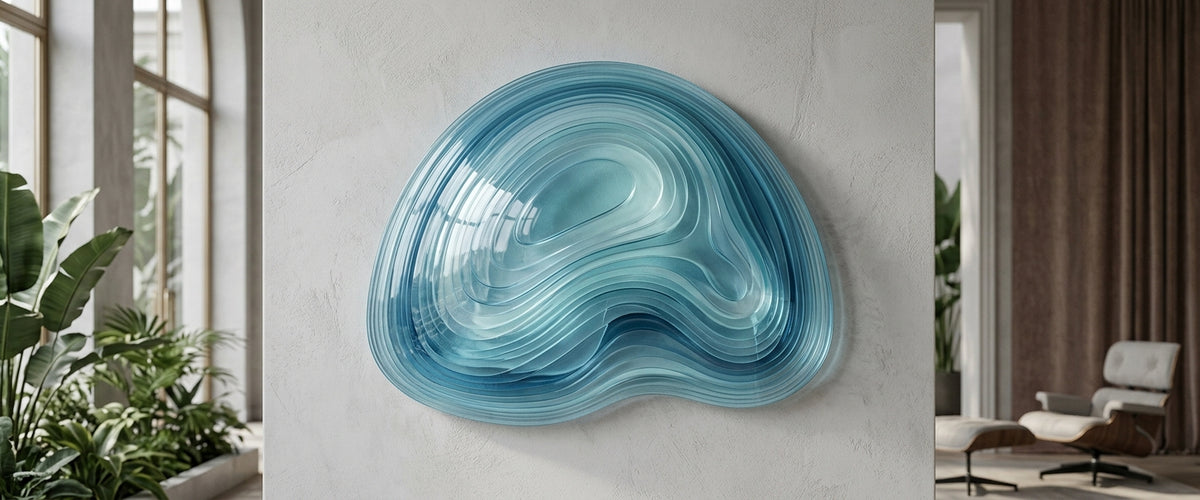

A flat printed panel and a piece of layered, light-catching acrylic can hang on the same wall and cost roughly the same, yet only one of them holds a room. That gap is what most people miss when they shop for acrylic wall art online. The glossy thumbnail looks great on a screen; the question is whether it still has presence at six feet away, in your actual light, on your actual wall. This guide is written from the buyer's side of that decision, with the scale and finish lessons we have learned shipping large statement pieces to homes and venues.
Acrylic is not a budget substitute for canvas. Used well, it does things paper and stretched fabric simply cannot: it carries depth, refracts light, and gives sculptural relief without the weight of metal or stone. Used badly, it is a shiny rectangle. The difference is in the spec.

Key Takeaways Before You Buy
Depth beats gloss. Three-dimensional or layered acrylic reads far stronger than a flat print under glass-like coating.
Scale is the most common mistake. Most buyers go too small for the wall by a noticeable margin.
Finish drives the mood. High-gloss amplifies color and light; matte and frosted calm a busy room.
Custom acrylic wall art lets you match size, color and relief to the exact space rather than compromising.
Hanging hardware matters as much as the piece; acrylic panels and 3D wall art need fixings rated for the real weight and standoff depth.

What Acrylic Wall Art Actually Is, and Who It Suits
At its simplest, acrylic wall art is artwork either printed onto, set behind, or sculpted from cast or extruded acrylic (PMMA). The category splits into three honest types. There is the flat printed kind, where an image is mounted to a clear acrylic face for gloss and color saturation. There is acrylic glass wall art, where the panel itself is the artwork and the clarity of the material does the work. And there is sculptural, layered or 3D wall art, where the acrylic is shaped, stacked or domed to throw shadow and catch light as you move past it.
That last group is where the material earns its keep. Where a piece is built on form rather than surface, such as the Dome Ice Blue Acrylic 3D Wall Art, it behaves differently at every angle because the dome itself does the work. This is the kind of buyer who is right for acrylic: someone who wants light, movement and a contemporary edge, and who has a wall that can carry a clean, modern object rather than a traditional framed scene.
If your interior leans classical or heavily textured, acrylic can still work as a counterpoint, but it tends to suit minimalist, mid-century and contemporary rooms best. Galleries, hotel lobbies, restaurant walls and modern garden rooms are natural homes for it.

How to Compare Acrylic Wall Art Options Before You Buy
Start with depth. Photographs flatten everything, so the first question for any acrylic art wall piece is how much physical relief it has. A panel with 3D form or stacked layers will photograph as merely "nice" and then surprise you in person. A flat print can look identical online and disappoint on the wall.
Next, look at edge quality. Cast acrylic holds a cleaner, more optically clear edge than cheaper extruded sheet, and on a clear or gradient piece the edges are part of the design. A layered design like the Helix Rosewood Spiral Illusion Acrylic 3D Wall Art only reads if the cutting and layering are precise; its spiral illusion collapses the moment the edges are sloppy.
Then weigh up color behavior. Gradient and fade designs, such as the Lattice Amber Fade Acrylic 3D Wall Art, shift as daylight changes through the day. That is a feature in a room with good natural light and a liability in a dim corridor where the gradient flattens out. Match the piece to the light it will actually live in.
Finally, consider UV stability. Reputable acrylic prints wall art uses UV-cured inks and UV-resistant material so color does not drift over years of sun exposure. Acrylic itself resists weathering and yellowing far better than many plastics, a point backed by material data from manufacturers such as Plexiglas (Röhm). Surface coatings and pigments are where aging tends to show, which is exactly why spec quality matters on anything you intend to keep.

Materials, Finishes and Scale Decisions
Three finish families cover most decisions. High-gloss is the loudest: it deepens color, mirrors light, and makes a piece feel wet and modern. It also shows fingerprints and reflects whatever is opposite it, so think about what the panel will mirror. Matte or satin calms the surface and reduces glare, which suits TV rooms and bright south-facing walls. Frosted and translucent finishes diffuse light beautifully and are worth considering where a piece sits near a window or backlight.
On scale, be braver than your instinct. The single most frequent regret we hear is that a piece arrived and looked smaller than the wall wanted. As a working rule, large acrylic wall art should fill roughly two-thirds of the available wall width above a sofa, console or headboard. For a double-height lobby or a long gallery wall, a single modest panel disappears; you either go large or run a deliberate series.
For lighter, color-led rooms, a soft gradient such as the Rippletone Bubblegum Gradient Acrylic UV 3D Wall Art can anchor a pale palette without going heavy. Where the brief calls for a single bold accent against a neutral wall instead, a saturated dome form like the Dome Crimson Red Acrylic 3D Wall Art is closer to the right register. Browse the full acrylic art collection to compare relief depth and color side by side, and the wider 3D wall art range if you want sculptural depth beyond acrylic.
Where to Place Acrylic Wall Art for Real Impact
For wider placement ideas, Office Wall Art That Earns Its Place on the Reception Wall is useful companion reading before finalising the setting and sightlines.
Light is the deciding factor. Acrylic loves raking light and directional spots; it dies under flat, even ceiling wash. In a living room with tall windows, a gradient piece on the opposite wall will change character from morning to evening, which is the whole point. In a windowless hallway, you will want a piece that reads on form and shadow rather than transmitted light, plus a discreet picture light or a pair of adjustable spots set at around a 30-degree angle.
Mind reflections. A high-gloss panel hung directly across from a bright window can become a mirror at certain hours. Either angle the lighting, choose a satin finish, or place the piece on a perpendicular wall so the reflection works for you rather than against.
For commercial settings, acrylic earns its place in hospitality and retail because it photographs well and survives high-traffic environments better than canvas. We have shipped sculptural acrylic work into restaurant and showroom interiors where it needed to look sharp under both daylight and evening lighting; the pieces that performed were the ones with genuine depth, because flat panels go dull the moment the room lights come up.
Budget, Commissioning and Delivery
There is no single price for acrylic wall art, and anyone quoting one without seeing your wall is guessing. Cost depends on size, the thickness and grade of acrylic, the complexity of the relief or layering, custom color matching, finishing, and the crating and freight needed to deliver it intact. A small flat panel and a large multi-layer sculptural commission are different products entirely. The honest move is to settle your wall dimensions and brief, then request a tailored quote.
If you are commissioning custom acrylic wall art, give the maker three things: the wall dimensions and the viewing distance, samples of your room's palette and light, and any reference images of forms or color you are drawn to. Lead time runs longer for bespoke than for stock, so plan around install dates rather than the other way around. For large or shaped panels, ask how the piece ships and whether it arrives ready to hang with hardware specified for its weight.
Quick Buyer Checklist
Confirm whether the piece is flat-printed or genuinely three-dimensional.
Check finish (gloss, satin, frosted) against the wall's light and what sits opposite.
Size to at least two-thirds of the wall feature width; go larger for double-height spaces.
Ask about UV-cured inks and material grade for long-term color stability.
Confirm the panel's weight and the recommended fixings before delivery day.
For custom work, lock dimensions, palette and lead time up front.
How Giant Sculptures Helps With Bespoke Acrylic Projects
Giant Sculptures works as a bespoke supplier across large-scale and statement pieces, and acrylic sits naturally alongside our work in metal, stone and engineered relief. The same discipline applies: get the scale right for the room, get the finish right for the light, and build the piece to last rather than to photograph once. If a stock design is close but not quite, we can advise on adjusting size, color or relief depth so the wall art on acrylic actually fits the space it is going into.
For projects that need to coordinate with sculpture elsewhere in a home or venue, it helps to view acrylic as one part of a larger scheme rather than an isolated purchase. A modern acrylic panel can sit in deliberate conversation with a freestanding piece or a metal wall sculpture, and planning them together keeps the whole room coherent.
How to Hang Acrylic Wall Art Properly
Hanging is where good pieces get ruined. Acrylic panels and 3D wall art often use standoff fixings that hold the piece slightly proud of the wall, which is part of the look and casts a clean shadow line. Mark your fixing points precisely, drill into solid backing or proper wall anchors rated above the panel's weight, and check the piece sits flat with a level before final tightening. For heavier sculptural panels, a French cleat or a multi-point fixing spreads load better than a single hook. If you are unsure of the wall construction, get a professional installer; an acrylic piece is expensive to replace and unforgiving if it falls.