






































































































Abstract sculpture is the hardest category to buy badly and the easiest to buy lazily. A figurative bronze tells you what it is the second you walk in. An abstract piece has to earn its space through form, material and the way light moves across it, which means the wrong choice sits in a room like a piece of furniture nobody likes. The right one quietly runs the room. This guide is for buyers, designers and collectors trying to land on the second outcome.

Quick Answer: What to Get Right Before You Buy
- Form first, material second. Decide whether you want vertical lift, horizontal calm, or a coiled, organic shape. Everything else follows.
- Scale up, not down. Most buyers under-size. A 4 ft (1.2 m) piece in a double-height room reads as a tabletop ornament.
- Match material to setting. Mirror-polished stainless steel for contemporary interiors, Corten and bronze for gardens, carved wood or stone for warmer, tactile rooms.
- Plan the base and the bolts. Plinth height, fixings and floor or ground load are part of the design, not an afterthought.
- Commission if nothing fits. Bespoke is usually the answer when the site has a specific sightline, ceiling height or symbolic brief.

What Is an Abstract Sculpture, and Who Is It For?
An abstract sculpture is a three-dimensional work that does not try to depict a recognizable subject in a literal way. It might suggest a figure, a wave, a wing, or a geological form, but it leaves the reading open. The viewer finishes the work. That is the whole point. The Tate's definition of abstract art is a good baseline: art that does not attempt to represent an accurate depiction of visual reality.
People sometimes ask what an abstract figure sculpture is, which sits between two camps. It keeps enough of the human silhouette (a head, a torso, a stretched limb) to read as a body, but distorts proportion, surface or pose so it becomes a study of form rather than a portrait. Henry Moore's reclining figures and Brancusi's elongated busts are the textbook references, and they are still the most useful entry points when explaining the genre to a hesitant client.
Who is abstract sculpture actually for? In our experience at Giant Sculptures, it works hardest for three buyer types. Architects and interior designers who need a piece to anchor a strong space without competing with the architecture. Collectors who want to live with art they can look at for twenty years without exhausting it. And commercial clients (hotels, headquarters, sculpture parks) who need a centerpiece that photographs well from every angle.
Materials, Finishes and the Decisions That Really Matter
Material is where most abstract sculpture projects either land or fall apart. The form might be the same in a sketch, but the same shape rendered in mirror stainless steel versus carved oak is genuinely two different artworks.
Stainless Steel
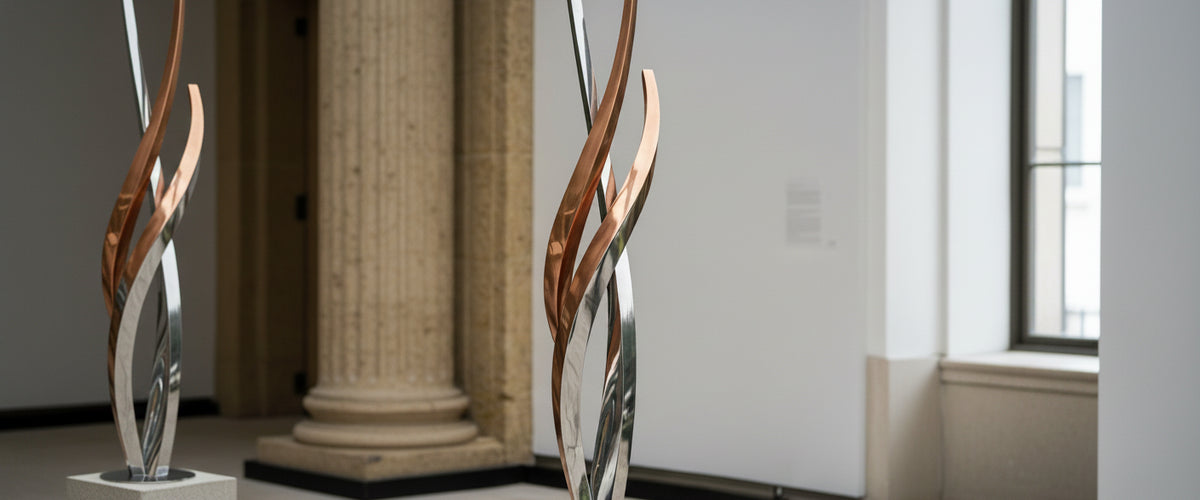
Stainless steel is the dominant material in contemporary abstract art sculptures, and for good reason. Mirror-polished surfaces dissolve the object into its surroundings, picking up sky, foliage and architecture. Brushed or satin finishes calm the form down and let the geometry speak. Coloured PVD coatings (copper, gold, bronze tones) give you the warmth of patinated metal with the structural advantages of steel. Where a project calls for a tall vertical accent that still feels warm against limestone or render, a copper-toned ribbon form such as the Strata Copper Abstract Steel Sculpture reads quite differently morning and evening; the same geometry in raw mirror finish would feel colder and more clinical.
Bronze
Cast bronze is the long-haul material. Patinas develop over decades, and a well-cast bronze in a Hamptons garden or a Napa courtyard will outlive its owners. Bronze suits weighty, grounded forms. It is less convincing for floating, ribbon-like shapes where stainless steel does the job better.
Corten Weathering Steel
Corten is the go-to for large outdoor abstract sculpture in landscaped settings. The rusted orange surface stabilizes after the first year or two and reads beautifully against grasses, gravel and stone. It is structural, weldable in big sections, and forgiving on cost relative to bronze at the same scale.
Stone and Marble
Carved stone slows everything down. It rewards organic, hand-shaped forms and looks honest in spaces that already carry weight: stone terraces, gallery interiors, formal entrances. Marble adds a quieter, more luminous surface but needs more thought about weathering and sealing in exposed sites.
Abstract Wood Sculpture
Abstract wood sculpture is the warm option. Carved oak, walnut, ash or reclaimed hardwoods bring grain and tactility into a room that metal cannot match. Wood is most successful indoors or under cover; outdoor wood pieces need species selection and finishing advice tailored to the climate. We tend to recommend wood for living rooms, libraries and hospitality interiors where guests will pass within touching distance.
Scale: The Mistake Almost Every Buyer Makes
The single most common error in buying abstract sculpture is choosing a piece that is too small. A sculpture that looks generous in a studio or on a showroom plinth often shrinks the moment it lands in a 20 ft (6 m) entrance hall or a half-acre lawn. As a working rule, the sculpture should read clearly from the furthest point a visitor will normally view it from. If your guests first see it from a driveway 80 ft (24 m) away, a 3 ft (90 cm) piece will disappear.
For interiors, we usually advise that a floor-standing abstract sculpture occupy at least one-third of the ceiling height. So a 10 ft (3 m) ceiling wants something around 40 inches (1 m) or taller, including the plinth. For gardens and grounds, think in terms of sightline rather than ceiling. A piece sited at the end of a long axial path can comfortably go to 8 to 12 ft (2.4 to 3.7 m) without overwhelming the planting.
Weight matters too. A solid cast bronze abstract at 6 ft (1.8 m) can run well over 400 lbs (180 kg). Fabricated stainless steel of the same height might be a fraction of that. This affects floor loadings on upper levels, foundation depth for outdoor installations, and the logistics of getting the work through doors, lifts and gates on delivery day.
Placement: Where Abstract Sculpture Actually Earns Its Keep
For wider placement ideas, Abstract Art Sculpture Home Decor: When a Shape Becomes the Room is useful companion reading before finalising the setting and sightlines.
Placement is where the editorial judgment happens. A few principles we apply on commissions we have shipped to clients in California, Texas and the Hamptons:
- Give it one strong sightline. Abstract pieces lose impact when surrounded by visual noise. Frame the work with a calm wall, a hedge, or a single architectural element behind it.
- Light it on purpose. A taller piece with reflective curves, like the Whisper Gold Abstract Steel Sculpture, changes character entirely under raking light from a low angle versus flat overhead light. Plan the lighting before the piece arrives.
- Avoid the dead corner. A sculpture pushed into a corner reads as decoration. Pull it forward so the viewer can walk at least partway around it.
- Use water and gravel sparingly. Reflective pools and pale gravel beds work beautifully for stainless and mirror finishes, but only when the surrounding planting is restrained.
- For interiors, think about the second view. The piece will be seen from the sofa, the stairs and the kitchen island. Walk all those positions before committing.
Hospitality clients often want a smaller signature piece on a console or reception desk. For that role, a compact, jewel-like form such as the Eclipse Gold Abstract Steel Sculpture - 44/48cm tends to make more sense than a scaled-down version of a floor piece: recognizable from across the lobby, photographed constantly by guests, and small enough to relocate when the space is redesigned.
Famous Abstract Sculptures Worth Studying Before You Buy
If you are building your eye, spend an afternoon with the canon. Brancusi's Bird in Space for the argument that abstraction can be more truthful than figuration. Barbara Hepworth's pierced forms for the relationship between mass and void. Henry Moore's reclining figures for scale and landscape. Anish Kapoor's mirrored work for what stainless steel can do at architectural scale. Richard Serra for sheer presence. Lists of the best abstract sculptures ever made are subjective, but those names will sharpen your judgment quickly. The MoMA collection notes on abstraction are a useful starting point if you want primary-source context.
Budget, Commissioning and Lead Times
Budget for abstract sculpture varies more than any other category because the inputs vary so widely. Material, scale, engineering, surface finish, base or plinth design, installation method, and shipping all move the number. Rather than quote a misleading range, we ask clients to share the site, the rough scale, the material direction, and any structural constraints. From there we can give a tailored quote within a few days.
If you are commissioning bespoke, expect the process to run something like this. A first conversation about intent, site and references. Concept sketches and material samples. A scale maquette or 3D render for sign-off. Fabrication, which for a large metal piece typically takes several months. Finishing, crating and freight. Installation on site, ideally with our team or a coordinated rigger.
How to make an abstract sculpture at this level is a studio question, not a weekend project. Serious work involves armature engineering, weld sequencing on stainless steel, controlled patination on bronze, and finishing schedules that can run weeks. Clients who want to understand the process are welcome to ask; we send progress photographs at each major stage on commissions.
How Giant Sculptures Approaches Abstract Commissions
Our focus is large-scale, durable work for clients who plan to live with the piece for decades. That shapes everything we recommend. We tend to push buyers toward materials that age well outdoors, structures that can survive a freight journey across the Atlantic without flexing, and forms that hold up under the harsh test of being seen every single day. The full range sits in our abstract sculptures collection, and the broader sculptures catalog shows how abstract work sits alongside figurative and animal pieces in mixed commissions. For interior-led projects, our home decor sculptures selection is the better starting point.
If nothing in stock matches the site, we commission. That is the part of the business we enjoy most, and it is usually where the strongest work happens.
For general conservation principles, V&A sculpture techniques is a useful external reference, though the final care routine should always follow the material and finish specified for the individual commission.