






















































































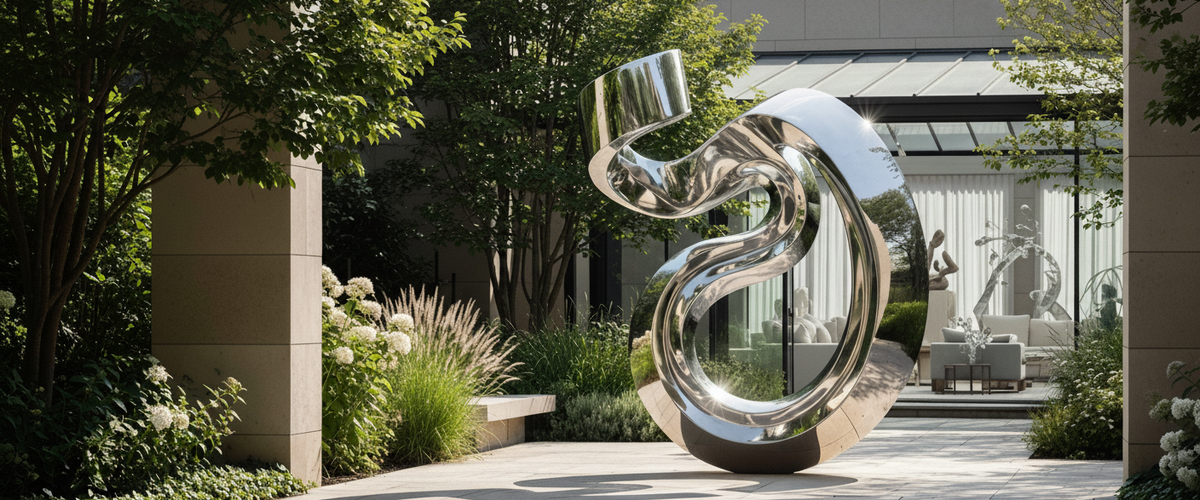

Most people buying modern art for the first time get stuck on the same question: is this piece serious, or is it just big? The honest answer almost always comes down to material, intent, and the room it has to live in. Modern art at its best feels deliberate. It holds a wall or a lawn the way a good piece of architecture holds a corner. It does not shout, and it does not apologise for taking up space.
At Giant Sculptures we spend most of our week talking to buyers who have already fallen for a piece online and now need to work out whether it will actually survive a Napa summer, fit through the doors of a Tribeca loft, or hold its own in a 40-foot atrium. This guide is built around those conversations.

Quick Answer: What to Know Before You Buy Modern Art
- Modern art covers roughly a century of work, from early 20th-century abstraction through to contemporary sculpture made today.
- For collectors, the practical questions are material, scale, finish, and where the piece will live for the next 20 years.
- Bronze, stainless steel, Corten, and stone are the durable backbone of serious outdoor pieces. Acrylic, resin, and LED work belongs indoors.
- Scale is the single most common mistake. Buyers go small. Architects and designers almost always push bigger.
- Budget depends on size, material, engineering, finishing, and installation. A tailored quote is the only honest figure.

What Modern Art Actually Means, and Who It Is For
The phrase covers a long stretch of history. In museum terms, modern art generally runs from the late 19th century through the mid-20th, with contemporary art taking over after that. In the buyer's market the line is blurrier. When a client says they want modern art, they usually mean clean lines, abstract or semi-abstract form, a confident material, and nothing that reads as traditional figurative work.
So who is it for? In our experience, four groups: private collectors building a coherent home, designers furnishing a new build, architects looking for a single anchor piece in a lobby or courtyard, and venue owners (hotels, vineyards, members clubs) who need a sculpture that photographs as well as it ages. If you sit in any of those camps, the rest of this guide is for you.
What Is Modern About Modern Art
The shift away from strict realism is the easy answer. The harder one is intent. Modern work tends to foreground material and form over narrative. A polished stainless steel curve does not tell you a story; it reflects the room back at you and asks you to notice it. That is the point. If you want a sculpture that reads like a novel, modern is not the category. If you want one that reads like a piece of music, it is.

Materials, Finishes, and Scale Decisions
Material drives almost everything else: longevity, weight, shipping cost, installation, and the way the piece looks at 7am versus 7pm. A short tour of what we recommend, and when.
Bronze
Still the standard for serious outdoor sculpture. Cast bronze handles weather, salt air, and decades of seasonal swing. Patinas range from deep chocolate browns through to greens and near-blacks, and a good foundry will mix patinas inside a single piece for depth. Bronze is heavy. A six-foot (1.8m) figure can run several hundred pounds (well over 150kg), which matters for plinth design and crane access on installation day.
Stainless Steel
Mirror-polished or brushed stainless is the material of choice for clean, contemporary form. It reads as modern instantly. A polished steel sphere or ribbon will pick up sky, grass, and architecture around it, which is why it works so well in front of glass-fronted homes in California or commercial plazas in Texas. Browse the stainless steel sculptures collection to see how finish changes the personality of the same form.
Corten Steel
Corten weathers to a deep rust-orange skin that then stabilises. It pairs beautifully with prairie planting, gravel gardens, and modernist architecture. Good for the Hamptons, Aspen, and anywhere the landscape itself is part of the composition. Buyers sometimes worry about runoff onto pale paving; the answer is a sealed base detail and a gravel drip zone, not avoiding the material.
Stone and Marble
For collectors who want weight and permanence without metallic sheen. Carrara, basalt, and limestone all carve well into abstract forms. Stone is the most labour-intensive option and the slowest to commission, but it ages the most gracefully of anything we ship.
Acrylic, Resin, and LED
These belong indoors. Acrylic and resin work sits well in apartments, studios, and hospitality interiors where natural light is controlled. Where a room calls for a graphic, photographic register rather than a freestanding form, a high-gloss acrylic piece such as the CineLuxe Modern Muse is closer to the right design language than a sculptural object on a console. LED and neon pieces (see the LED and Neon art collection) are statement work for bars, lounges, and double-height living spaces. Do not put any of these outside; UV and temperature swings will cost you.
Scale
The biggest mistake we see is buyers going one size down because the big version feels intimidating in a catalog photo. In situ, the smaller piece almost always disappears. Our rule of thumb for outdoor work: the sculpture should read clearly from the furthest point a visitor will see it from. For a front garden, that is usually the street. For a rear garden, it is the back of the house. Measure that distance, then size the piece so its silhouette reads at that range. Indoors, the piece should occupy roughly two-thirds of the visual height of its host wall or alcove.

Where to Place Modern Art for Real Impact
For wider placement ideas, Flower & Plant Art for Modern Homes: How to Style Botanical Wall Paintings Like a Pro is useful companion reading before finalising the setting and sightlines.
Placement is half the job. A few principles that hold across almost every project we ship.
Give the piece a sightline. Modern sculpture needs an approach. A driveway turn, a hallway view from the front door, the line from a kitchen island to a back garden. Without an approach, the piece becomes furniture.
Light it twice. Daylight does most of the work, but a single warm uplighter at the base transforms a sculpture after dark. For metallic finishes, aim slightly off-axis so the highlight is not a flat blob.
Mind the background. A polished stainless piece against a busy hedge will fight for attention and lose. Against a clipped yew wall, a rendered garden wall, or open sky, it sings. Corten wants a quieter, leafier backdrop. Bronze handles almost anything.
Respect the plinth. A serious piece deserves a serious base. Poured concrete, honed stone, or a low steel platform set into gravel will all read better than an off-the-shelf pedestal. We design plinths as part of most bespoke commissions because the base changes how the sculpture sits in the eye.
For interior placement, the modern art collection covers the full range of formats: wall pieces, freestanding figures, and abstract forms scaled for residential rooms.

Budget, Commissioning, and Delivery
Honest pricing in this category depends on material, scale, complexity of form, engineering, surface finishing, crating, and installation. A four-foot (1.2m) cast bronze abstract and a 12-foot (3.7m) mirror-polished stainless steel piece are not in the same conversation. Rather than quote ranges that mislead, we build a tailored quote per project once we know the brief.
For bespoke commissions, the typical sequence we run with clients is:
- Brief. Room, garden, sightlines, materials you already live with, and reference images.
- Concept sketches and a 3D maquette. This is where scale gets tested honestly. We render the piece into your actual site photo where we can.
- Material and finish sign-off. Patina samples, polish levels, and edge details approved before fabrication.
- Fabrication. Typically several months for serious work. Bronze casting and stone carving take longer than fabricated steel.
- Crating, freight, and installation. We ship worldwide. For US deliveries we coordinate with local riggers and craning where the piece warrants it.
A few buyer mistakes worth avoiding: signing off on a maquette without standing it in the actual space, choosing a finish from a swatch instead of a sample in your own light, and underestimating access. We have had more than one project where the sculpture cleared every measurement except the angle of the side return. Send us the access photos early.
How Giant Sculptures Approaches Bespoke Modern Work
Most of what we ship is either large-scale or bespoke, and often both. Our studio works across bronze, stainless steel, Corten, and stone, with engineering support for anything that needs internal armature, wind-load calculation, or specialist fixings. For US clients we have shipped pieces into private homes, vineyards, and hospitality sites from the West Coast to the East. The work that lasts in those settings is rarely the cheapest version of itself; it is the one where the material, scale, and base were chosen together rather than separately.
If you are considering a commission, the most useful first step is a conversation about the site. Specifications follow from that, not the other way around. For background reading on how museums think about contemporary materials and their long-term care, the American Institute for Conservation publishes useful technical guidance that informs how we specify finishes for collectors.