






















































































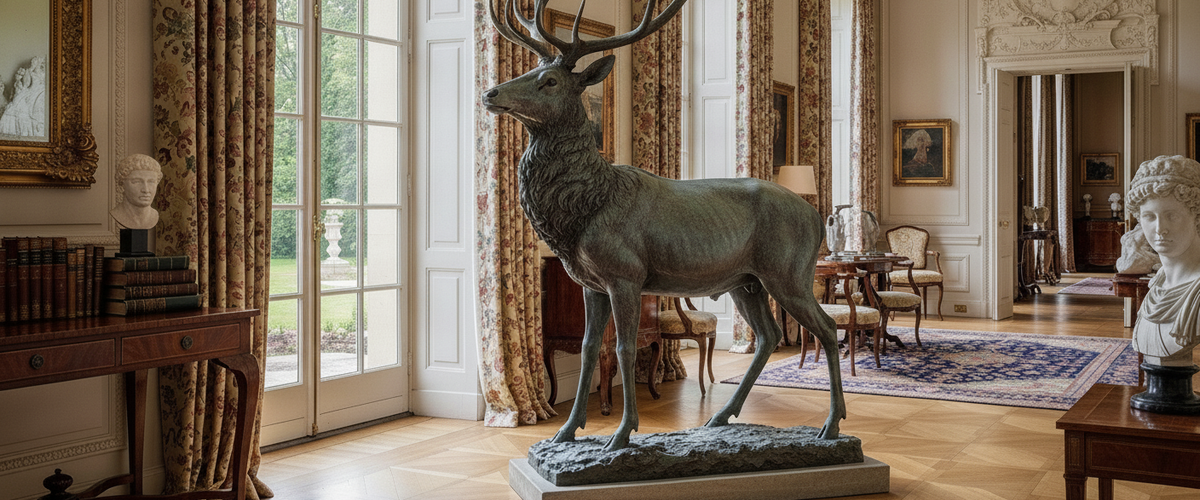

A 12-inch clay hare on a shelf and a 12-foot bronze stag on a Napa hillside are not the same problem with different dimensions. They are different objects entirely. The hare lives or dies on a thumbprint near the eye. The stag lives or dies on whether the back leg can carry the weight of the front quarters through a Sonoma summer. Buyers who treat animal sculpture as one category, scaled up or down, end up with pieces that look wrong on arrival, and the cause is almost never the sculptor's talent. It is a mismatch between scale, medium, and the species itself.
This guide is the one we wish more clients read before briefing us. It pulls from commissions we have shipped to private gardens in the Hamptons, ranch entrances in Texas, and corporate plazas in the Midwest, and from the small studio pieces that quietly sell every week. If you are weighing an animal sculpture for a home, a garden, or a commercial site, the decisions below matter more than style.

Key Takeaways
Small animal sculpture rewards surface and gesture. Large animal sculpture rewards anatomy and engineering.
Clay reveals the hand. Bronze hides it and shows silhouette and mass instead.
Anatomy errors get bigger, not smaller, when you enlarge a maquette.
Famous animal works almost always picked the right size for the species, not the biggest possible size.
Budget for an animal sculpture depends on material, scale, complexity, engineering, finish, and installation. Ask for a tailored quote rather than a category price.

Why a 12-Inch Clay Hare and a 12-Foot Bronze Stag Obey Different Rules
At tabletop size, the viewer reads an animal sculpture from about three feet away. The eye scans surface first: the tool marks across the flank, the press of a thumb behind the ear, the way the clay caught the light where the sculptor pinched it. Anatomy matters, but it forgives a lot. A hare can be slightly stylized and still read as a hare because the gesture, ears pinned, haunches loaded, carries the species.
At twelve feet, the viewer reads silhouette from forty feet, then walks closer. Surface barely registers from distance. What matters is the outline against sky or hedge, the negative space under the belly, the proportional truth of the head to the chest. Get those wrong and no patina or polish will fix it. A bronze stag with a head ten percent too small will look like a calf wearing antlers from any approach. We have seen it happen on pieces by capable studios. The maquette read beautifully at 18 inches; the enlargement read like a different animal.
What Clay Reveals That Bronze Hides, and Vice Versa
Clay is honest about the hand. Every press, every tool stroke, every moment of doubt sits on the surface. For collectors who want intimacy, an animal clay sculpture at 8 to 16 inches is often the right answer. It belongs on a shelf, a console, a study desk. Small-scale terracotta animal studies in major museum holdings, including those at the Getty, show what the medium does at its best: immediacy, observation, a sense the sculptor was looking at the animal that morning.
Bronze is the opposite. Lost-wax casting absorbs the hand and gives back mass, weight, permanence. A bronze animal at garden scale becomes architecture. It anchors a lawn the way a mature tree does. It can be patinated to read warm or cold, matte or polished, and it will outlast the building it sits beside. For outdoor commissions in the US, bronze is still our most-requested material; pieces from our bronze animal sculptures collection routinely ship to estates where the brief is fifty years, not five.
Stainless steel and Corten sit between the two. Stainless gives you a hard, reflective animal that reads almost graphic from distance, useful when the surrounding architecture is modern. Corten gives you a warm, weathered outline that suits hillsides and meadows. Neither shows the hand the way clay does, and neither carries the weight of association that bronze does. Choose them for the look, not as a budget substitute.
Easy Animal Clay Sculpture Is Not the Same as Good Animal Sculpture
Search around and you will find endless tutorials on easy animal clay sculpture projects: pinch-pot owls, coil-built tortoises, slab-built foxes. These are wonderful as a way into the craft. They are not, however, what you commission for a permanent collection. The gap between a weekend clay sculpture animal and a piece that will hold its own in a hallway for thirty years is mostly about anatomy and firing, not skill at smoothing.
If you are buying rather than making, the clay piece you want has been observed from a live animal or skeleton, built around an armature that respects the load lines, and fired or cast properly so it survives a move across the country. Ask the studio how the piece was developed. "From photographs" is a yellow flag at any scale above 12 inches. "From a mounted skeleton at the natural history museum, then refined from field sketches" is what you are paying for.
The Anatomy Mistakes That Survive Enlargement and Ruin the Piece
Five errors recur often enough that we check for them on every animal commission before sign-off:
Head-to-body ratio drift. Sculptors enlarging from a small maquette often hold the head static and grow the body, because the head feels finished. The animal ends up looking juvenile or, worse, like a different species.
Leg cross-section too thin. A deer's lower leg looks delicate in life because it is dense bone. In bronze at 1.5x life size, that same silhouette becomes structurally fragile and visually weak. The leg needs to be slightly thickened to read correctly and to carry weight.
Eye placement and depth. Predator eyes face forward; prey eyes sit to the side. Get this wrong and a wolf reads like a dog, a hare reads like a kitten.
Hoof and paw contact. The animal must look like it is standing on the ground, not hovering above it. This is an engineering problem as much as an aesthetic one. Plinth integration matters.
Symmetry traps. Real animals are never perfectly symmetrical. A piece that mirrors left to right looks dead. We deliberately introduce asymmetry: a turned ear, a shifted weight, a flick of tail.
Famous Sculptures of Animals and What They Got Right at Their Chosen Size
The canon of famous sculptures of animals is a useful school. The bronze horses of San Marco in Venice work at near life size on a balcony because the architecture frames them; enlarged to thirty feet they would collapse into kitsch. Rembrandt Bugatti's small bronzes of panthers and anteaters from the early 20th century work at roughly 12 to 24 inches because his observation was intimate; he was modeling animals he had watched for hours at the Antwerp Zoo. Davide Rivalta's life-size bronze buffalo and wolves succeed because he installs them at ground level, in plazas and courtyards, where you meet them as you would a real animal.
The pattern across the canon is consistent. Great animal sculpture picks a size that matches what the sculptor was actually responding to. A jeweler's bench bronze of a beetle, a tabletop hare, a life-size hound, a monumental elephant: each works because the sculptor chose the scale the observation demanded, not the scale that filled the budget.
Balloon, Cast, Carved, Wire: How the Medium Changes the Species
The same animal becomes a different cultural object depending on how it is made. A balloon animal sculpture in polished stainless steel reads as pop, ironic, knowing; the species is almost incidental. A chicken wire animal sculpture reads as gesture and shadow, beautiful in a lit hallway but fragile outdoors. A carved marble hound reads as classical, aristocratic, weighty. A cast bronze hound reads as enduring, slightly melancholic, traditional in the best sense.
Pop-inflected work follows the same logic in a different register. Where a courtyard calls for a wink rather than gravitas, a piece in the language of Animal Lion Labubu Sculpture 160cm sets a very different tone from a patinated bronze lion of the same height, even though both occupy the same footprint. This matters when you brief a studio. "I want a deer" is the start of the conversation, not the end. Deer in Corten on a Colorado ridge says one thing; deer in polished stainless on a Miami lawn says another; deer in patinated bronze under an old oak in Connecticut says a third. None is wrong. They are different sentences in different languages. Our animal sculptures collection deliberately spans these voices because the right answer depends on the site and the owner, not on a house style.
Choosing the Right Scale for the Animal You Actually Want
A practical checklist we use with clients:
Measure the viewing distance. If the primary view is 60 feet across a lawn, you need a piece that holds its silhouette at that range. Anything under 4 feet (about 1.2 m) will read as ornament, not as sculpture.
Match species to scale honestly. A hare at life size is 18 to 24 inches long. A stag at life size is 4 to 5 feet at the shoulder. Pushing a hare to 8 feet or shrinking a stag to 18 inches creates a novelty object. Sometimes that is what you want. Usually it is not.
Check the foundation. A monumental bronze can weigh 1,500 to 3,000 pounds (roughly 680 to 1,360 kg). The pad, the access route, and the crane swing all need to be planned before casting begins.
Decide the patina or finish before the wax stage. Changing your mind after casting is expensive and sometimes impossible.
Plan for maintenance. Outdoor bronze should be re-waxed periodically; conservation guidance from bodies such as the American Institute for Conservation is worth reading before the piece arrives.
Scale choice within a single species also changes the piece's job on site. A 100cm figure such as Animal Kangaroo Labubu Sculpture 100cm works as a courtyard or entry-hall accent that meets you at waist height, while the same character pushed to 160cm becomes a floor-anchoring focal point that dominates sight lines from across a room. The species hasn't changed; the role of the object in the space has.
Commissioning Bespoke Animal Sculpture With Giant Sculptures
Most of our animal commissions start with a site photograph, a rough size, and a species. From there we work through maquettes, anatomy reviews, material samples, and finish trials before a piece goes to foundry or workshop. The process protects clients from the mistakes above and gives the sculptor enough time to actually observe the animal rather than reproduce a stock pose.
Budget depends on material, scale, complexity, engineering, finish, and installation logistics. A small interior bronze and a monumental outdoor commission with structural engineering sit at very different points, and we quote each piece individually rather than offer category prices that mislead. If you have a site in mind, the most useful next step is a brief that includes the location, the intended viewing distance, and any species you are drawn to. The rest of the conversation tends to follow naturally from there.
For wider placement ideas, Garden Sculptures Inspired by Nature: Organic Forms You’ll Love is useful companion reading before finalising the setting and sightlines.