





































































































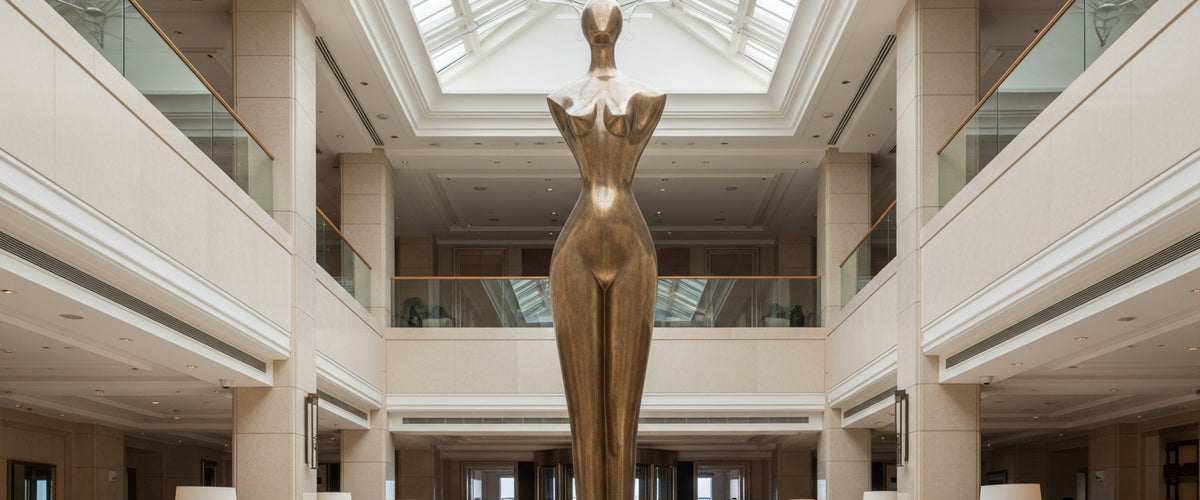

A guest walks through the revolving door, eyes adjust, phone is already half-raised. You have roughly three seconds before that guest decides whether your property feels generic or unforgettable. A well-briefed hotel lobby sculpture is one of the few interior elements that can win that moment outright, and it has to keep winning it through ten thousand check-ins a year. This is not decor. It is brand infrastructure.
At Giant Sculptures we work with hospitality groups, design studios, and owner-operators on bespoke large-scale work for lobbies, atriums, porte-cocheres, and pool decks. The brief for a hotel lobby sculpture is always the same in spirit, even when the style swings from neoclassical to brutalist: the piece must perform on first sight, on Instagram, and on a wet Tuesday in February when no one is looking.

Key takeaways
- The three-second test matters more than any single design choice. Scale, silhouette, and placement decide whether a hotel lobby sculpture reads from the door.
- Material is brand language. Polished bronze, Corten, stainless steel, and stone each send a different signal before a guest reads a single word of signage.
- Public-space durability is a separate spec from gallery durability. Finishes on a hotel lobby sculpture have to survive luggage, fingerprints, cleaning crews, and HVAC swings.
- Lighting is half the commission. A great sculpture under bad light is a bad sculpture.
- Hospitality timelines are unforgiving. Plan the hotel lobby sculpture commission against the FF&E schedule, not the soft opening.

The three-second test every hotel lobby sculpture has to pass
Hospitality designers talk about the arrival sequence, and the lobby sculpture is its punctuation mark. From the entry threshold, the piece has to register as a single confident silhouette before any detail is read. That means the form should hold up at roughly 30 to 60 feet (9 to 18 meters), which is the typical distance from a hotel's main doors to its central feature wall or rotunda.
Hotel lobby sculptures that fail this test are usually too busy, too low, or scaled to a residential room rather than a double-height lobby. As a rough starting point, a freestanding figure in a lobby ceilinged at 18 to 24 feet (5.5 to 7.3 meters) wants to be at least 7 to 9 feet (2.1 to 2.7 meters) tall before you start losing it visually against the architecture. Suspended or atrium work obviously scales up from there.

Brand storytelling through material and scale
Material choice is shorthand. A polished bronze figure says heritage, permanence, and old money. Mirror-finish stainless steel reads contemporary, photogenic, urban. Corten steel signals a property that is comfortable with patina, with grit, with a slightly unpolished design language, which is why it shows up so often in resort and desert hospitality. Hand-carved marble or limestone leans into European luxury cues without needing to spell it out.
The famously camp Las Vegas Venetian hotel lobby sculpture program on the Strip is an extreme case of material storytelling, where gilded classical figures and frescoed ceilings work together to sell a fantasy. The opposite pole is something like a contemporary Osaka hotel with a sculpture in the lobby, often a single restrained piece in steel or lacquered wood, doing all of its work through proportion and emptiness. Both approaches are valid. The mistake is picking a material because it is fashionable rather than because it carries your brand.
Our classic sculptures collection is a useful reference when a property wants a figurative, heritage-register hotel lobby sculpture, while the metal sculptures collection covers the contemporary and abstract end of hospitality briefs. For atrium work where a piece needs presence without crushing structural loads, large-scale composites have a place too, and the fiberglass sculptures collection is worth a look for suspended or oversized forms.

Sightlines from the entrance, the elevator, and the front desk
One of the most common briefing errors is treating the hotel lobby sculpture as a single-axis object. In practice, guests see it from at least three angles that matter commercially:
- The entrance, which sets first impression and social-media framing.
- The elevator lobby, which is the last image guests take upstairs and the first they see coming down for breakfast.
- The check-in desk, where guests spend two to ten minutes with the piece in their peripheral vision.
Each of those views should be designed, not accidental. A figurative piece with a clearly defined front and back will frustrate the elevator approach unless you orient it carefully or commission a fully in-the-round form. Abstract metal work and gestural figures tend to be more forgiving here, which is one reason hotel lobby metal sculpture design has trended toward forms that read well from 360 degrees.
Durability in high-traffic public space
Public-space durability is not the same as gallery durability. A museum piece is roped off and dusted by a conservator. A lobby piece gets touched, photographed against, leaned on, occasionally climbed on, and cleaned by housekeeping using whatever is on the cart that morning. The infamous incident in which a teen destroys a sand sculpture in the lobby of the Royal Hawaiian Hotel is the extreme version of a daily risk; that sand sculpture in the lobby of the Royal Hawaiian Hotel is also a reminder that temporary or fragile media simply do not belong in unsupervised public space. If you want sand, ice, or paper as a brand moment, treat them as scheduled installations with a documented lifecycle, not as permanent commissions.
For permanent hotel lobby sculpture work, we typically specify:
- Bronze with a sealed patina and an annual wax cycle. The American Institute for Conservation publishes useful guidance on outdoor and high-traffic bronze care (culturalheritage.org) that is worth sharing with your FM team.
- 316 marine-grade stainless steel for mirror or brushed finishes, especially in coastal properties where chloride exposure will pit lesser grades.
- Corten only where runoff staining onto stone or concrete has been engineered out.
- Stone and marble with a penetrating sealer and a no-citrus, no-vinegar cleaning protocol written into the housekeeping SOP.
Whatever the material, the commissioning conversation should include a written care schedule and a named point of contact at the studio. A sculpture hotel lobby installation is a 20-year asset; treat it like one.
Lighting: the difference between drama and glare
Lighting is where most hotel lobby sculpture commissions either come alive or quietly fail. The two failure modes are flat ambient wash, which makes a sculpture look like a prop, and aggressive uplighting, which throws hard shadows onto the ceiling and creates glare in guest photos.
A workable default for a figurative or semi-figurative piece is a primary key light at roughly 30 to 45 degrees off vertical, a softer fill from the opposite side at lower intensity, and a subtle accent that picks out one signature feature, the face, a hand, the leading edge of a wing. For mirror-polished stainless work, you are essentially lighting the room around it, because the sculpture's surface is a reflector. For Corten and matte stone, color temperature matters more than intensity; warm 2700K to 3000K flatters those surfaces, while cooler temperatures make them look dead.
Insist on a mockup or at least a lighting test on the actual piece before sign-off. Renderings lie.
Commissioning timelines for hospitality projects
Hotels have hard opening dates, and sculpture is one of the few FF&E categories that cannot be expedited by paying more. Bronze casting, stone carving, and large-scale metalwork have physical timelines that do not compress. As a planning rule of thumb, a substantial bespoke hotel lobby sculpture should be briefed 9 to 14 months before the opening date, broken down roughly as:
- Concept and maquette: 6 to 10 weeks, including two rounds of revisions with the design team and ownership.
- Engineering and approvals: 4 to 8 weeks for structural sign-off, anchor design, and any AHJ requirements.
- Fabrication or casting: 16 to 32 weeks depending on material, scale, and finish complexity.
- Finishing, crating, freight, and install: 6 to 12 weeks, with international shipping the most common point of slippage.
Budget for a bespoke hotel lobby sculpture depends on material, scale, structural engineering, finishing complexity, freight, and on-site installation. Rather than quoting a band that will not survive contact with your actual brief, we prefer to scope the piece against your lobby drawings and return a tailored quote. That conversation is usually faster than designers expect.
A quick pre-commission checklist
- Confirm ceiling height, floor load, and any structural slab limits with the engineer of record.
- Lock the arrival sightline drawing and the three secondary sightlines before approving a maquette.
- Decide whether the hotel lobby sculpture needs to be in-the-round or has a defined front.
- Specify material grade, not just material family, especially for stainless steel in coastal properties.
- Write the cleaning and maintenance SOP into the housekeeping manual on day one.
- Coordinate lighting design with the sculptor, not after the piece arrives.
- Build at least a four-week buffer between scheduled install and soft opening.
Done well, a hotel lobby sculpture stops being a line item and starts being a reason guests remember the property. Done badly, the hotel lobby sculpture is the most expensive thing in the room that nobody photographs. The difference is almost always in the brief.
For wider placement ideas around a hotel lobby sculpture, Sandstone Art Panels That Redefine 3D Wall Decor is useful companion reading before finalising the setting and sightlines.
For general conservation principles, Canadian Conservation Institute outdoor object care is a useful external reference, though the final care routine should always follow the material and finish specified for the individual commission.