





































































































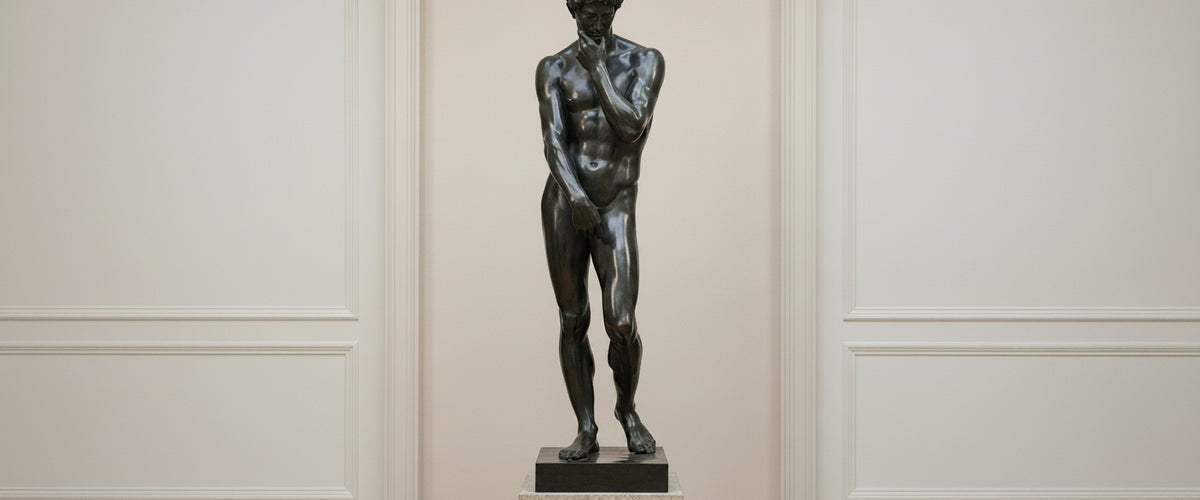

There's a specific moment when life size statues stop being decoration and start rearranging the room. You step through the door, your eye lands on a figure that meets you at your own height, and the whole space recalibrates. It's the same instinct that makes you slow down in front of a Rodin or a Bernini. The trouble is, that effect collapses fast when the ceiling is two inches too low, the floor can't take the load, or the lighting turns a serious sculpture into a department-store mannequin.
At Giant Sculptures we commission and ship life size pieces into private homes, hotels, ranches and corporate lobbies across the US, and the same handful of mistakes come up again and again. This guide is the conversation we have with buyers before they sign off on a 1:1 figure.

Key takeaways before you buy a life size statue
- Scale is architectural, not decorative. A life size figure needs ceiling height, sightlines and floor strength on its side.
- Material dictates everything downstream: weight, price, longevity, insurance and how easily you can ever move the piece.
- Bronze and marble are forever materials; resin and fibreglass are lighter and more affordable, but read differently up close.
- Lighting is half the artwork. A good figure lit badly looks like a prop.
- Budget depends on material, scale, complexity, engineering and finishing rather than any single sticker price. Always request a tailored quote.

The psychological shift when a figure matches human height
A 3-foot (91 cm) tabletop bronze is an object you look at. A 5'8" (173 cm) bronze figure is a presence you negotiate with. That shift from object to presence is the entire reason collectors commission life size statues, and it's why the category behaves differently from any other sculpture purchase.
Once a figure reaches roughly 5 to 6 feet (152 to 183 cm), the brain reads it as another body in the room. That's powerful in a double-height entrance hall in Aspen or a Napa winery tasting room, and it's claustrophobic in a standard 8-foot ceiling den in suburban Dallas. Before you fall in love with a specific piece, walk the room with a tape measure and a piece of cardboard cut to the sculpture's silhouette. If your guests would have to swerve around it, the room isn't ready.

Ceiling, doorway and floor-load realities most buyers forget
Three measurements decide whether a life size statue can actually live where you want it:
- Ceiling height. Leave a minimum of 12 inches (30 cm) of breathing room above the figure's head. A 6-foot bronze under a 7-foot ceiling looks trapped.
- Doorway and stair clearance. Measure the narrowest point on the delivery route, not just the front door. Tight turns at the top of a stairwell have ended more installations than weight ever has.
- Floor load. A life size marble figure on a plinth can sit at 1,000 lb (450 kg) or more. On a suspended timber floor in a Manhattan brownstone, that's a structural conversation, not a styling one.
For outdoor placements, add frost heave, drainage and base anchoring to the list. The Getty Conservation Institute publishes useful guidance on outdoor sculpture stewardship that's worth reading before you commit to a permanent exterior install.

Resin, bronze and fibreglass at 1:1: weight, cost and movability compared
Material is where romance meets logistics. Here's how the three most common options behave at life size:
Bronze
The reference standard for life size statues. Cast bronze figures typically weigh between 250 and 600 lb (113 to 272 kg) depending on wall thickness and pose. They patinate beautifully, survive outdoors for generations, and hold resale value. The trade-off is weight, lead time and cost; bronze is a commissioned piece, not an impulse buy.
Marble and stone
Heavier still, often 800 to 1,500 lb (363 to 680 kg) for a carved figure on a plinth, and unmatched for classical subjects. For a formal garden or chapel courtyard where a 1:1 carved marble figure is the right answer, a piece like the Life-Size Angel Marble Outdoor Sculpture - 180cm shows how the material reads at human height; where the architecture can carry something taller and more ceremonial, the Gold Life-Size Angel Marble Outdoor Sculpture - 225cm sits closer to the right register. Marble needs sealing and shelter from acid rain in industrial areas.
Stainless steel and Corten
The contemporary alternative. Mirror-polished stainless gives you a life size figure that reflects its surroundings and almost disappears at certain angles; Corten gives you a rust-stabilised surface that reads beautifully against planting. Both are excellent for commissioned, abstracted or stylised figures, including a life size anime statue or character-driven brief where bronze would feel too traditional.
Fibreglass and resin
Lighter (often 80 to 200 lb / 36 to 91 kg), cheaper, and easier to move between rooms or floors. Useful for film, retail, fan-driven commissions like a life size Gojo statue, or temporary installations. Up close, resin doesn't have the cold weight of bronze or the grain of stone, and it's more vulnerable to UV and impact. We use it when the brief genuinely calls for it; for a permanent statement piece, we'll usually steer clients to metal or stone.
Entrances, stairwells and double-height rooms that earn a life size piece
Not every room deserves a life size statue. The ones that do tend to share three qualities: a long approach, generous ceiling height, and a clear focal axis. A few placements that consistently work:
- Entrance halls with a sightline from the street. The figure becomes the first and last thing guests see.
- Stair landings in double-height stairwells. A figure positioned on a half-landing reads from both floors.
- Garden axial points. A life size horse statue at the end of a gravel walk in a Hamptons garden, or a marble figure closing a parterre, gives the landscape a vanishing point worth walking toward. In that kind of setting, a draped figure like the Life-Size Garden Angel Marble Outdoor Sculpture - 180cm closes the axis without overwhelming the planting.
- Hotel and restaurant arrival sequences. Lobbies, courtyards and the pivot point between bar and dining room.
For exterior schemes, our Life Size & Large Statues collection is a useful place to gauge how different subjects and materials read at full scale before you brief a bespoke commission.
Lighting a figure so it reads as art, not waxwork
The fastest way to ruin a serious life size statue is a single overhead downlight. Flat top light flattens the face, blacks out the eyes, and pushes the whole figure toward kitsch.
What works instead:
- Two-point lighting at roughly 30 to 45 degrees from the figure's centerline, slightly above head height. This sculpts the form the way the artist intended.
- Warm color temperature (2700K to 3000K) for bronze and marble; cooler (3500K to 4000K) for stainless steel and contemporary finishes.
- A grazing light along one side for textured surfaces like Corten or hand-finished bronze, to reveal the tooling.
- Dimmable circuits. A life size figure should look different at 11am and 11pm.
Outdoors, uplighting from two angles at the base, plus a soft fill from a nearby tree or wall, gives the figure dimension after dark without the floodlit-monument effect.
Commissioning a bespoke life size statue
Most of the life size pieces we deliver are commissioned rather than bought off the floor. The brief usually starts with a subject (a portrait, a horse, a character, a religious figure) and a location, and works backward through material, finish, base, engineering and installation.
A few things that make a commission go smoothly:
- Share the site early. Photographs, ceiling heights, floor build-up and the delivery route matter more than mood boards at the briefing stage.
- Decide on permanence. Indoor, outdoor, or movable between the two? That single answer eliminates half the material options.
- Approve a maquette. A scaled study lets you correct pose and proportion before any expensive material is cut or cast.
- Plan the install. Crane access, stair runners, floor protection and anchoring all need to be scoped before delivery day, not on it.
Buyer mistakes we see most often
- Choosing the figure before measuring the room.
- Underestimating the weight of marble or bronze on a residential floor.
- Specifying resin for a permanent outdoor install in a sunny climate.
- Lighting from a single overhead source.
- Forgetting that a 6-foot figure on a 2-foot plinth is an 8-foot object.
- Skipping the maquette stage on a portrait commission.
Get the architecture, material and lighting right, and a life size statue stops being a gimmick and starts doing the job the best figurative sculpture has always done: holding a room together and giving people a reason to stop talking for a second.
For wider placement ideas, The Gacko Bear Revolution: Limited-Edition Life-Size Sculptures by André Gacko is useful companion reading before finalising the setting and sightlines.
For general conservation principles, V&A sculpture techniques is a useful external reference, though the final care routine should always follow the material and finish specified for the individual commission.