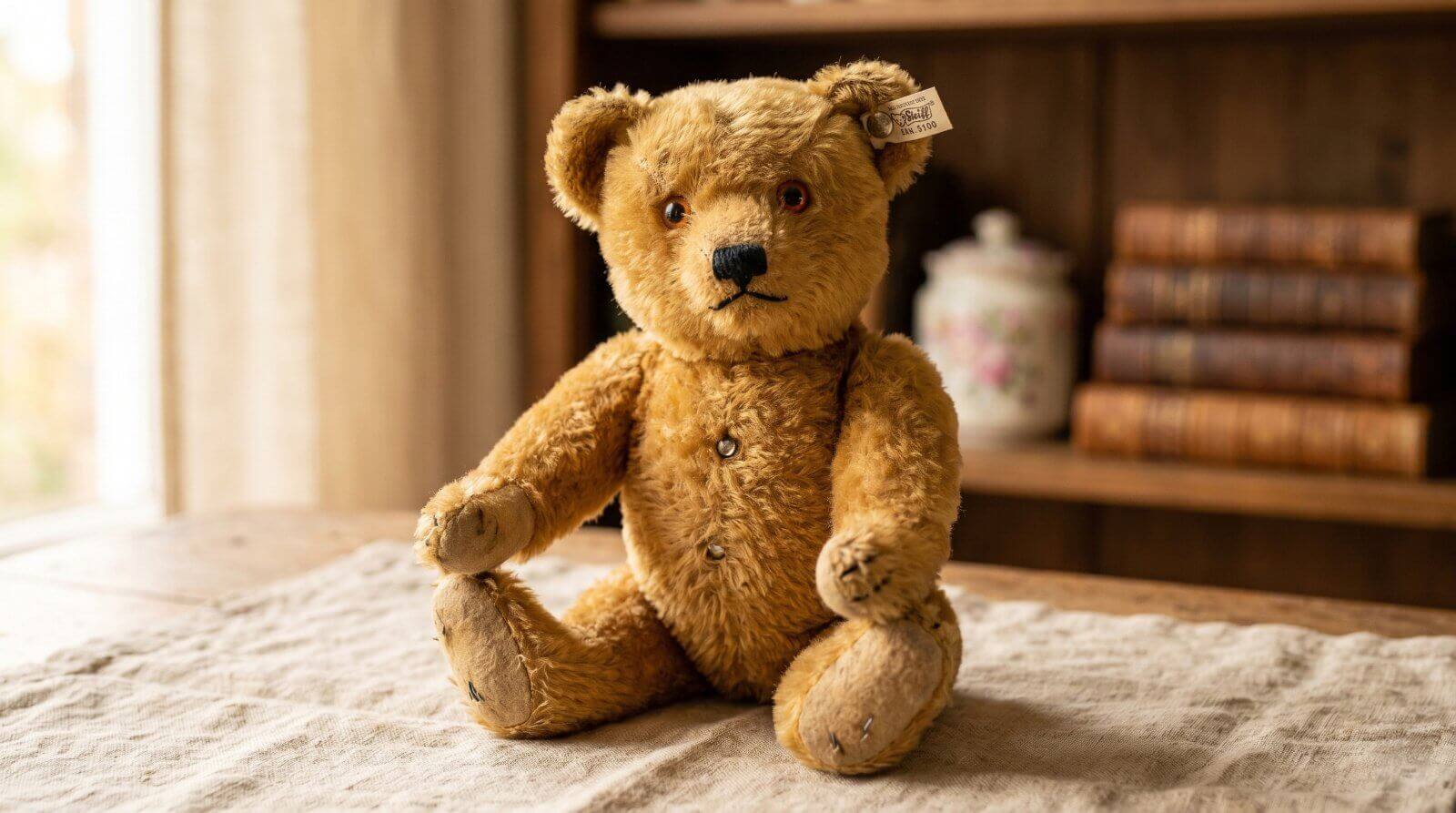

The Bear That Took Over the World
In the autumn of 1902, two things happened on opposite sides of the Atlantic that nobody at the time could have guessed would combine into one of the most enduring toys ever made, and into the opening chapter of teddy bear history.
In Mississippi, the President of the United States refused to shoot a bear. In Germany, a seamstress and her nephew were sketching out a prototype for a jointed stuffed bear. Within three years, both developments had converged into a single object, the teddy bear, and by 1907, teddy bears were selling in numbers that bankers couldn't believe and factories couldn't keep up with. That convergence is the hinge point of teddy bear history.
This is the complete teddy bear history of the original toy: who invented it, why it's called a 'teddy' bear, how two independent origin stories ran in parallel, and how a stuffed bear became one of the defining cultural objects of the 20th century. We've written it as a timeline so you can trace each step clearly, and we've included the key people, places, and moments that most teddy bear histories leave out.
Before the Teddy Bear: Stuffed Animals and the Edwardian Toy Trade
To understand why the teddy bear took off so quickly, it helps to understand what came before it. Stuffed animal toys existed long before 1902 (rag dolls, stuffed rabbits, stuffed cats, stuffed dogs were all common in the late 19th century). What didn't exist was a stuffed bear. Bears, in the Victorian and Edwardian imagination, were wild and dangerous; circus attractions, hunting trophies, symbols of nature's threat. The idea of a bear as a child's comfort object would have seemed faintly absurd. Any honest history of the teddy bear has to start with that absence.
This matters because it explains the leap that both the Michtoms in Brooklyn and the Steiffs in Germany had to make. They weren't just producing another stuffed animal in an established category. They were inventing the idea that a bear could be cuddly, which is the actual founding moment of teddy bear history.
1902: The Roosevelt Hunting Trip
In November 1902, President Theodore Roosevelt (known to friends and press as 'Teddy', though he himself reportedly disliked the nickname) travelled to Mississippi to help settle a border dispute between Mississippi and Louisiana. While there, he accepted an invitation from state governor Andrew H. Longino to join a hunting party near the town of Onward.
The hunt did not go to plan. After several fruitless days, Roosevelt's hunting guides, eager to produce a kill for the President, tracked and cornered an old, injured black bear, clubbed it into submission, and tied it to a willow tree. They then summoned Roosevelt, suggesting he shoot the bear for the honour of the hunt.
Roosevelt refused. He considered shooting a tethered, injured animal deeply unsportsmanlike and ordered the bear to be put down humanely, which, by most accounts, was done with a knife by another member of the hunting party. But he would not fire the shot himself. That refusal is where the teddy bear history we know actually begins.
The Berryman Cartoon
The story was reported in the American press within days. On 16 November 1902, Clifford K. Berryman, a cartoonist for the Washington Post, published a cartoon titled 'Drawing the Line in Mississippi' showing Roosevelt, rifle pointed away, refusing to shoot a small, cowering bear held on a rope by a hunter. The cartoon combined political commentary (Roosevelt 'drawing the line' on a border dispute) with the hunting story.
Berryman's bear was deliberately small and soft-featured, cartoon-cute rather than menacing. In subsequent cartoons over the following years, Berryman continued to use this bear as a Roosevelt motif, and the bear shrunk and softened in each iteration. By the time the teddy bear toy appeared in early 1903, the Berryman bear had already established 'a small, cuddly bear' as an image in the American public imagination, and that image is the visual seed of teddy bear history.
1902-1903: Morris and Rose Michtom in Brooklyn
Morris Michtom was a Russian-Jewish immigrant who ran a small candy and novelty store on Tompkins Avenue in Brooklyn, New York, with his wife Rose. Rose Michtom was a skilled seamstress who made small stuffed toys to sell alongside the candy. Their shop is the American origin point of teddy bear history.
After seeing the Berryman cartoon in late 1902, Rose sewed two small stuffed bears, plush, soft, button-eyed, and Morris placed them in the shop window with a hand-written sign: 'Teddy's Bear'. The response was immediate. Customers wanted one; then more customers wanted one. Morris sent a sample to President Roosevelt, asking for permission to use the name 'Teddy's Bear' commercially. The exact wording of Roosevelt's reply has been romanticised in retellings of teddy bear history over the years, but the substance was that he agreed, reportedly saying he didn't think the use of his name would benefit the toy business much, but Michtom was welcome to try.
Ideal Novelty and Toy Company
By 1903, the Michtoms had incorporated the Ideal Novelty and Toy Company to meet demand. Within a few years, Ideal was one of the largest toy manufacturers in the United States, and it remained a major player in American toymaking until the 1980s. The original 'Teddy's Bear' (the first bear Rose Michtom sewed) now sits in the Smithsonian's National Museum of American History in Washington DC, preserved as one of the foundational objects of 20th-century American childhood and a touchstone of teddy bear history.
1902-1903: Richard Steiff in Giengen, Germany
While the Michtoms were starting their candy-store experiment in Brooklyn, a parallel chapter of teddy bear history was unfolding in the small town of Giengen an der Brenz in southern Germany. Margarete Steiff, a remarkable woman who had contracted polio as a child and used a wheelchair, had been running a successful felt-toy business since the 1880s, initially producing pincushions shaped as elephants, then expanding into a full range of stuffed felt animals.
In 1902, her nephew Richard Steiff joined the business as a designer. Richard had studied art and was fascinated by the brown bears he observed at Stuttgart Zoo. Over 1902 and into 1903 he sketched and prototyped a new kind of stuffed bear, not the rigid, awkward stuffed bear that other toy companies had attempted, but a fully jointed bear with movable arms, legs, and head, covered in mohair (long-pile fabric that resembled real fur).
The 55 PB Bear
Richard's first production-ready bear, the '55 PB' (standing roughly 55cm tall, with the code referring to size and design, 'Plüsch Beweglich' meaning 'plush movable'), was launched at the Leipzig Toy Fair in March 1904. The reception was initially cool; German buyers thought it was too fragile and expensive. Then, in the final hours of the fair, a buyer from the American firm George Borgfeldt & Company, typically cited as Hermann Berg, placed an order for 3,000 bears. That single order is one of the most consequential moments in teddy bear history.
Within a year, Steiff was producing teddy bears by the tens of thousands. In 1907 alone, Steiff produced nearly 974,000 bears. The factory in Giengen had to expand repeatedly to keep up with demand.
The Button in Ear
In 1904, to protect the Steiff brand against imitators, the company introduced the 'Knopf im Ohr' (Button in Ear) trademark, a small metal button affixed to the left ear of every Steiff animal. This button, with minor design changes, has remained on Steiff bears for over a century and is the most reliable way to authenticate vintage Steiff pieces. Pre-button Steiff bears (produced before 1904) are extraordinarily rare and prized among teddy bear history collectors. 
So Who Actually Invented the Teddy Bear?
This is one of the most asked questions in teddy bear history, and the honest answer is: both did, independently, in the same year, on different continents.
The Michtoms in Brooklyn gave the toy its name. 'Teddy bear' comes from Roosevelt's nickname, via Morris Michtom's 'Teddy's Bear' shop display. Without the Roosevelt cartoon and the Michtom bear, the toy would never have been called a teddy bear at all.
The Steiffs in Germany gave the toy its form, the fully jointed, mohair-covered, movable-limb bear design that became the template for every serious teddy bear that followed. Without Richard Steiff's 55 PB, the teddy bear as an object would be nothing like what we recognise today.
The Michtoms and the Steiffs produced their first bears in the same twelve-month window, with no apparent communication between them. The Michtoms started first (late 1902) but remained small-scale through 1903. The Steiffs launched commercially in March 1904 and scaled enormously. Both are legitimately 'first teddy bear' creators, which is why teddy bear histories credit one or the other depending on whether they emphasise naming or form.
Why Are They Called Teddy Bears?
Teddy bears are called teddy bears because of Morris Michtom's 'Teddy's Bear' shop display in Brooklyn in 1902-1903, which took its name from Theodore 'Teddy' Roosevelt and the Berryman cartoon of Roosevelt refusing to shoot the tethered bear in Mississippi. It's the naming clause every teddy bear history has to include.
The name spread quickly through toy trade press and newspaper coverage of the Roosevelt bear-sparing story. By 1906 the term 'teddy bear' was in general use; by 1907 it was the near-universal English-language name for the stuffed bear toy, displacing earlier terms like 'bruin' or simply 'plush bear'.
A small historical irony worth knowing if you care about teddy bear history: President Roosevelt disliked the nickname 'Teddy' and asked associates not to use it. The name of the most famous toy in American history is based on a presidential nickname the President himself didn't particularly care for.
1906: The Name Enters Mainstream Use
In 1906 and 1907, 'teddy bear' appeared in American and British newspapers as a description, not an explanation, a sign that the term had become widely understood. The Ladies' Home Journal, Harper's Bazaar, and the Times all carried teddy bear references in this period. Vaudeville acts incorporated teddy bears. Songs were written about them. The toy became a kind of cultural shorthand for the Edwardian moment: modern, affectionate, a little sentimental.
1907: The Teddy Bear Craze
1907 was the year the teddy bear boom peaked in the United States, and it's the year most teddy bear history books linger on. American manufacturers (Ideal, Bruin, Columbia, Aetna, Strauss) were producing teddy bears around the clock. Steiff alone shipped nearly a million bears, most of them to the US. Newspapers reported 'teddy bear weddings' (staged events where two bears were married in costume), teddy bear photography studios, teddy bear dances. There were concerns about whether the craze would damage doll sales; the Michigan Catholic issued a sermon in 1907 warning that teddy bears were causing girls to neglect baby dolls and would, by extension, damage their maternal instincts.
The craze cooled naturally over 1908-1910 but the teddy bear was by that point a permanent fixture. What had been a fashion object was now simply a category, like the rag doll. Teddy bears were part of the standard toy trade.
1921: Christopher Robin and Winnie-the-Pooh
On Christopher Robin Milne's first birthday in August 1921, his parents A.A. Milne and Daphne Milne gave him a teddy bear bought at Harrods, a bear made by the London-based J.K. Farnell & Co., manufacturers of high-end teddy bears in Acton, West London. The bear was initially named 'Edward Bear', then 'Mr. Edward Bear', before Christopher Robin renamed him 'Winnie-the-Pooh' ('Winnie' after Winnipeg, a black bear at London Zoo whom he visited often, and 'Pooh' after a swan Christopher had earlier named).
A.A. Milne began writing stories featuring Winnie-the-Pooh in 1925. 'Winnie-the-Pooh' was published in 1926, followed by 'The House at Pooh Corner' in 1928. The original bear now lives at the New York Public Library's Stephen A. Schwarzman Building on Fifth Avenue, where he has been on display since 1987.
The Winnie-the-Pooh phenomenon did something important in teddy bear history: it permanently moved teddy bears from 'toy' to 'character'. A teddy bear wasn't just a generic object; a teddy bear could have a name, a personality, a world. This cultural shift laid the groundwork for every named teddy bear that followed: Paddington (created by Michael Bond in 1958), Rupert Bear (created by Mary Tourtel in 1920), Corduroy (Don Freeman, 1968), and hundreds more.
1920s-1940s: The Teddy Bear as Comfort Object
Through the 1920s, 1930s, and 1940s, teddy bears evolved from novelty into a deep cultural fixture, the part of teddy bear history that often gets compressed into a single sentence. Several things happened in parallel:
- Teddy bears became the standard gift for newborns and young children across both the US and UK
- Manufacturers diversified; Merrythought (founded 1930 in Shropshire, UK) became a major British producer, joining the earlier Chad Valley and Chiltern Toys
- World War II briefly disrupted production, with mohair and stuffing materials diverted to war effort; wartime teddy bears are often smaller, with synthetic fabrics
- Teddy bears became associated with childhood comfort, grief, and memory in ways that went well beyond toy status; surviving bears from this period carry extraordinary emotional weight for the families that preserved them
1960s-1970s: The Premium Collectible Bear Emerges
By the 1960s, the teddy bear market had split into two distinct tiers: mass-market bears (GUND, which had been making plush since 1898, scaling up; various mid-market manufacturers) and premium collectibles. Steiff had never stopped producing premium hand-finished bears, and by the 1970s a serious adult collector market was developing around them, particularly for pre-war Steiff pieces, which is when teddy bear history started being written as scholarship rather than nostalgia.
In 1974, Peter Bull (British actor and teddy bear enthusiast) published 'Bear with Me' (in the US, 'The Teddy Bear Book'), which is often credited as the book that formalised adult teddy bear collecting as a hobby. Bull's collection of several hundred bears travelled to museums; his advocacy legitimised adult bear ownership as a serious cultural activity.
1981: Vermont Teddy Bear Company
In 1981, John Sortino founded the Vermont Teddy Bear Company in Shelburne, Vermont, initially selling handmade teddy bears from a pushcart in Burlington. The company grew into one of the best-known American teddy bear manufacturers, known especially for its 'Bear-Gram' delivery service: having a teddy bear shipped in a gift box as an alternative to flowers. Vermont Teddy Bear Company remains a significant US teddy bear brand today and a fixture in late-20th-century teddy bear history.
1985: The Teddy Bear Museum Opens
In 1985, Gyles Brandreth opened the Teddy Bear Museum in Stratford-upon-Avon, England, the first dedicated teddy bear museum in the UK and the first institution to treat teddy bear history as a museum subject. The museum displayed hundreds of vintage and celebrity-owned bears. Though the original museum closed in 2006, the concept spread: teddy bear museums opened in the US, Germany, Japan, Korea, and elsewhere through the 1990s and 2000s.
1994: The £110,000 Teddy Bear
On 5 December 1994, a 1904-1905 Steiff bear known as 'Teddy Girl' sold at Christie's London for £110,000 (approximately £240,000 in 2026 money) to Japanese collector Yoshihiro Sekiguchi, founder of the Izu Teddy Bear Museum. The sale was the highest price ever paid for a teddy bear at auction at the time and a watershed in teddy bear history; it confirmed what collectors already knew: early Steiff bears had entered the serious auction market as genuine art objects. The record was broken in 2000 when a Steiff 'Louis Vuitton' bear sold for £132,000, and again over subsequent years; the market for early Steiff bears has remained strong.
1997: Build-A-Bear Workshop
In 1997, Maxine Clark founded Build-A-Bear Workshop in St. Louis, Missouri, a retail-experience concept where customers (primarily children) choose an unstuffed bear, participate in the stuffing and finishing process, and take home a personalised bear they've helped make. Build-A-Bear grew rapidly through the 2000s, opening hundreds of workshops across North America, the UK, Ireland, and Asia, and fundamentally changed how children engaged with the teddy bear purchase, turning it from a passive gift-receiving moment into an active making experience. It's the retail chapter of teddy bear history.
2000s-2010s: Giant Teddy Bears and Designer Sculptures
Through the 2000s and 2010s, two parallel teddy bear trends emerged that are worth highlighting because they define the modern chapter of teddy bear history.
The first was the rise of giant teddy bears: genuinely enormous plush bears, often 150cm-300cm+ (roughly 5-10ft) tall, sold primarily as Valentine's Day gifts, graduation gifts, and statement presents. Costco's giant teddy bear, launched in the 2010s, became a genuine cultural phenomenon. Giant teddy bears shifted teddy bears from 'childhood companion' back toward 'statement gift', the same territory the original 1907 craze had occupied.
For context on giant teddy bears specifically, see our complete guide to the Costco giant teddy bear comparison.
The second trend was the rise of the designer bear sculpture, not a stuffed bear at all, but a solid sculpture in resin, fiberglass, or bronze, shaped as a stylized bear and used as an interior statement piece. Designer bear sculptures emerged in the late 2000s and grew rapidly through the 2010s alongside the rise of designer collectibles more broadly (Bearbricks, Labubu, KAWS, Popmart). They're sold as fine-art sculpture rather than as toys, with prices from £150 up to tens of thousands. They're the most recent twist in teddy bear history.
Giant Sculptures specialises in this category. See our bear sculpture collection for the full modern designer bear range, from 30cm desk pieces to life-size 170cm+ floor-standing sculptures.

Today: The Teddy Bear in 2026
The teddy bear in 2026 is a remarkably diverse object, and any honest teddy bear history has to account for all of its current forms. Depending on where you look, it can be any of the following:
- A traditional child's soft toy, mass-produced at low cost and available in every supermarket
- A premium handmade collectible, produced by Steiff, Merrythought, Charlie Bears, and artisan bear-makers, with prices from £100 to £2,000+
- A vintage auction object, with early 20th-century Steiff pieces trading for tens to hundreds of thousands of pounds
- A giant plush gift (Valentine's Day, graduation, proposal prop) often life-size or larger
- A designer sculpture in resin, fiberglass, or bronze, positioned alongside Bearbricks, Labubus, and balloon dogs in the contemporary interior sculpture market
- A character (Paddington, Winnie-the-Pooh, Corduroy, Mr Bean's Teddy, Ted) sustaining entire franchises across books, film, and merchandise
What unites all of these is the same basic idea that Rose Michtom and Richard Steiff arrived at independently in 1902-1903, the founding principle of teddy bear history: a bear can be friendly. A bear can be cuddled. A bear can be part of a home. Everything that's followed in the 120+ years since has been variations on that one simple, slightly radical Edwardian realisation.
Where to See the Originals
If you want to see genuine original teddy bears from the 1902-1910 period in person, the main places to visit, the working archives of teddy bear history, are:
- The Smithsonian National Museum of American History, Washington DC; home of the original Michtom 'Teddy's Bear'
- The Steiff Museum, Giengen, Germany; the company's own historical collection, including early 55 PB and 35 PB bears
- The V&A Museum of Childhood (now Young V&A), London; British teddy bear history including Chad Valley, Merrythought, J.K. Farnell pieces
- The New York Public Library, Fifth Avenue; home of the original Winnie-the-Pooh and friends
- Bethnal Green Museum, London; major doll and teddy bear collection
For the contemporary end of the story (giant teddy bears, designer bear sculptures, the modern evolution) that part of teddy bear history is still being written, and you'll find it in homes, galleries, and interior design showrooms rather than museums.
Looking for Your Own Statement Bear?
If reading this teddy bear history has you thinking about adding a bear to your own home, whether a classic teddy aesthetic or a contemporary designer sculpture, Giant Sculptures stocks the UK's widest range of large bear sculptures, from designer pieces at 30cm up to life-size bears at 170cm+. Browse our bear sculpture collection, or our large bear sculptures.
And if the history itself interested you (if you're the kind of reader who enjoys tracing how ordinary objects became cultural monuments) we'd recommend Patricia N. Schoonmaker's 'A Collector's History of the Teddy Bear' (still the scholarly standard for teddy bear history) and the Steiff company's own excellent historical archives, much of which is available online.